
- Democracy
- Government and public services
- Carnegie UK
- 23 April 2026
- ISBN: 978-1-917536-13-4
- 24 minute read
Executive summary
This report summarises polling commissioned by Carnegie UK and conducted by the research agency Savanta to better understand the views and opinions of elected representatives across the UK in relation to deliberative democracy.
This work forms part of Carnegie UK’s Engaging Democracy programme, which aims to contribute to improving democratic wellbeing for people across the UK, with a focus on participatory and deliberative democracy. We undertook this work to understand how parliamentarians across the UK understood and perceived this important area of democratic innovation.
The surveys in each jurisdiction were conducted in late 2025 and gathered responses from MPs, MSPs, MSs and MLAs, weighted to reflect the political composition of each legislature. Key findings from this work include:
- Elected representatives across the UK display cautious openness to deliberative democratic approaches, alongside recurring concerns about legitimacy, role duplication, and institutional capacity to adopt these processes.
- Concerns about duplication of roles were widespread.
- Attitudes varied by jurisdiction, with elected representatives in devolved nations consistently more positive about the potential of deliberative processes.
- Whilst there was relatively low optimism overall, left‑leaning elected representatives were more likely to believe deliberation could enhance trust between the public and democratic institutions and help resolve entrenched problems, while right of centre elected representatives were more doubtful.
- Sitting in Westminster further shaped attitudes: Conservative MPs were consistently more sceptical than Labour MPs about these processes, but this pattern was less consistent in devolved contexts.
- Levels of prior awareness and direct experience of deliberative democracy varied across jurisdiction. MSPs in Scotland were the most familiar and most likely to have participated in or observed a deliberative process, while MLAs in Northern Ireland were the least familiar overall.
- Across devolved legislatures, around three‑quarters of representatives indicated they either would consider or had already taken part in a deliberative democratic process. Westminster MPs were notably more sceptical, with over a third saying they would not consider involvement.
Introduction
Democratic wellbeing means that we all have a voice and choice in decisions that affect our lives. However, we know that across the UK there are currently low levels of trust in our democratic institutions and systems. Carnegie UK’s Life in the UK index for 2025 shows that democratic wellbeing in the UK scored just 41 out of a possible 100, far lower than scores seen for other areas of our collective wellbeing.
To better understand these issues and explore potential solutions, our Engaging Democracy programme has looked at what can be done to improve people’s democratic wellbeing. In particular, we have sought to explore how better institutionalising deliberative democratic processes into existing legislatures could, over time, help to improve the democratic wellbeing of people across the UK.
At Carnegie UK, we believe that deliberative democracy can play an important role in improving our democratic wellbeing and contribute to restoring trust between citizens and their elected representatives. When designed and delivered well, these initiatives can help to grapple with complexity and policy trade-offs to usefully inform decision-making and complement traditional democratic processes. This view is supported both by our own work in this area to date and by a growing body of international evidence and best practice.
Key to this is improving our understanding of the current attitudes and opinions of elected representatives across the UK to these democratic innovations.
In 2025 Carnegie UK commissioned the polling agency Savanta to survey a sample of elected representatives in each legislative jurisdiction across the UK with the purpose of understanding how sitting elected representatives engaged with and perceived deliberative democratic initiatives.
This report provides an overview of our analysis, findings and conclusions from this data.
Methodology
In order to understand elected representatives’ perceptions of democracy and democratic processes, in mid-2025 Carnegie UK commissioned the polling agency Savanta to conduct research amongst this group. The sample Savanta surveyed was of elected representatives in line with the make-up of each parliament and assembly by political party.
Sample sizes and fieldwork dates were:
- 100 UK MPs: 5th September to 8th October 2025.
- 40 MSPs in Scotland: 16th September to 7th December 2025.
- 33 MLAs in Northern Ireland: 19th September to 24th November 2025.
- 30 MSs in Wales: 16th September to 1st December 2025.
It should be noted that throughout this report when looking at sub-groups in particular the base sizes become quite small. As such, sub-group analysis should be treated as indicative results. All surveys were completed online. The questions were asked as part of a longer survey including questions about other topics.
The questions asked around deliberative democracy were designed to:
- Assess awareness and attitudes toward deliberative democracy.
- Evaluate perceived capacity and willingness of institutions to adopt deliberative democratic practices.
- Identify key barriers and actors responsible for advancing deliberative democracy.
Respondents to the survey were not self-selected, as they are members of Savanta’s parliamentary panels. By agreeing to be a member of a panel, members are unaware of the surveys and topics that they will be asked to respond to. The data for each group of elected representatives has been weighted to be representative of the party-political make-up of each legislature.
Savanta is a member of the British Polling Council and abides by its rules.
What do we mean by deliberative democracy?
The following description was provided to elected representatives at the start of the survey to offer definition and context to the subject of the survey:
‘Deliberative democracy describes a suite of “processes through which people can engage in open, respectful and informed discussion and debate with their peers on a given issue” (Electoral Reform Society, 2019). It is grounded in bringing a demographically representative group of people together to engage in informed dialogue and reasoned exchange, with the aim of reaching a consensus view that influences decision-making processes. It includes methods like citizens’ assemblies, citizens’ juries, and citizens’ panels. Tools like participatory budgeting and public consultation on policy or strategy documents are not considered to be forms of deliberative democracy.’
Key findings by jurisdiction
Distinct patterns emerged across the UK Parliament and the three devolved legislatures. While many themes are consistent across all elected representatives, clear jurisdictional differences emerge in awareness, openness, perceived value, and institutional capacity relating to deliberative democracy.
UK Parliament
Westminster MPs showed the least experience with deliberative democracy and were the most sceptical across the measures. Just under two‑thirds had heard of deliberative democracy prior to the survey, and only a small minority reported any direct experience of participating in or observing such a process. More than a third said they would not consider taking part in a deliberative process, a substantially higher proportion than in any devolved legislature.
Just over a third of MPs agreed that deliberative democratic processes would increase trust between the public and democratic institutions, and just under a third felt it would help resolve entrenched problems.
Party‑political differences were starkest at Westminster. Conservative MPs were considerably less open to deliberative democratic approaches than Labour MPs, and they were also much less likely to believe that deliberation could help increase trust between the public and democratic institutions. Concerns about legitimacy and duplication of roles were pronounced, with many MPs expressing an apprehension that deliberative processes could undermine parliamentary authority or appear to outsource decision‑making.
MPs were also among the least optimistic about institutional capacity, both at UK and devolved levels. However, the small number of those with direct experience of deliberative processes tended to hold more positive views of capacity than those without experience, suggesting that familiarity may soften some scepticism.
Scottish Parliament
MSPs demonstrated the highest levels of awareness and prior engagement with deliberative democracy. A large majority were already familiar with deliberative processes, and almost a third had been involved in or had observed one.
There was an openness to deliberative democracy, with around three‑quarters of MSPs saying they would consider taking part in a deliberative process. However, a notable minority still expressed reluctance.
Fewer than half of MSPs felt that deliberative democratic processes could increase trust between the public and democratic institutions, and just over a third that they would help resolve entrenched problems within society. Conservative MSPs were the least optimistic about deliberative democracy across the board, though had similar levels of knowledge and openness to other party representatives.
MSPs were among the most optimistic about the capacity of institutions, especially local government, to adopt and act on deliberative findings. However, concerns remained about resource requirements, procedural constraints and political culture. Unlike in other jurisdictions, MSPs with prior experience were not consistently more positive about the potential benefits of deliberative practices, indicating a more complex relationship between experience and attitudes.
Senedd
The majority of MSs in Wales had heard of deliberative democracy before the survey, and around a quarter had direct experience. Openness was relatively strong, with roughly three‑quarters saying they would consider taking part. Less than half of MSs felt that deliberative democratic processes could improve trust between the public and democratic institutions, while a third agreed they could help resolve entrenched problems.
As in other legislatures, prior experience with deliberative techniques was associated with reduced concerns about duplication of democratic functions.
In terms of institutional capacity, MSs were moderately positive about devolved institutions but lacked confidence in the ability of UK Parliament and UK Government to adopt deliberative approaches. MSs were also comparatively more likely to feel that civil society should play a lead role in responding to concerns about public trust in democracy.
Northern Ireland Assembly
Overall, MLAs were the least familiar with deliberative democratic initiatives, yet they expressed comparatively strong optimism about their potential.
While awareness and direct experience were lower than in other jurisdictions, more than half of MLAs felt that deliberation could help address deep-rooted challenges and increase trust between the public and democratic institutions.
Openness to deliberative processes was mixed: around three‑quarters said they would consider taking part, but around a quarter said they would not. MLAs with direct experience were far less likely to see deliberation as duplicating elected representatives’ work. However, resource constraints, political culture, and procedural barriers were commonly cited concerns from MLAs in relation to the effective adoption of deliberative democratic processes.
Knowledge and experience of deliberative democracy
The findings show that prior knowledge and experience of deliberative democratic processes vary among elected representatives across the UK, as does their openness to these processes. Figure 1 below shows their awareness of deliberative democracy.
Figure 1 clearly demonstrates the differences in experience of deliberative democracy between jurisdictions.
Specifically, a large majority (84%) of MSPs in Scotland had heard of deliberative democracy before the survey, followed by three-quarters (76%) of MSs in Wales and just over two-thirds (69%) of MPs. MLAs in Northern Ireland were however the least likely to have heard of deliberative democracy, with 44% saying they had never heard of it prior to the survey.
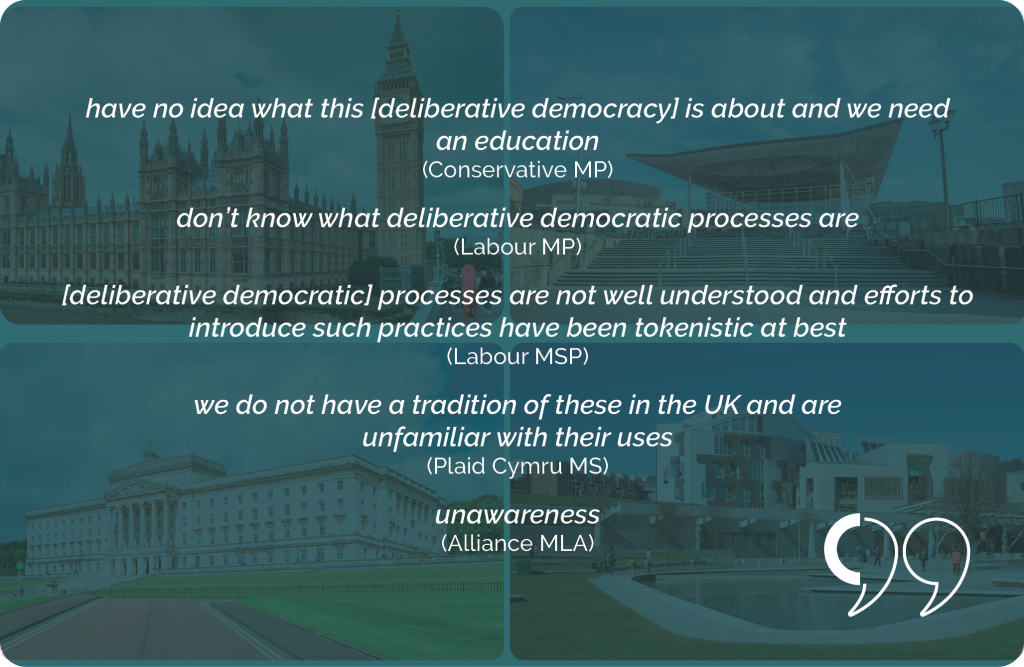
Some elected representatives noted that this uneven knowledge of deliberative democratic processes within their legislature was a key barrier either for themselves or for others in their institutions, with some of the quotes given shown below.
While elected representatives’ awareness of deliberative processes varied between jurisdictions, there was less variation in relation to how likely they were to say that they had taken part in and/or would consider taking part in such processes, as shown in Figure 2.
In each of the devolved nations, around three-quarters of elected representatives polled said that they either have already or would consider being a part of deliberative democratic processes.
In contrast, just over a third of Westminster MPs (36%) said they would not consider being part of a deliberative process, with Westminster MPs also the most sceptical about deliberative democracy in general.
Variance by political party
Of those surveyed, representatives of generally left-leaning and of pro-independence political parties were more likely to say that they would consider being part of a deliberative democratic process, while representatives of right-leaning parties were less likely to say this.
This appears partially to be a compounding factor of jurisdictional differences in these findings, with elected representatives in Westminster being the least likely overall to consider engaging in deliberative democratic processes, and Conservative MPs being particularly unlikely to consider being part of a deliberative democratic process. Three in five (60%) Conservative MPs said that they would not consider being part of a deliberative democratic process, more than double the proportion of Labour MPs who said this. This party-political leaning was not, however, consistent across all jurisdictions.
These findings suggest that the institution of the Westminster Parliament is itself a factor in reducing the likelihood of elected representatives being open to deliberative democratic processes.
When asked about the perceived barriers to legislative institutions adopting deliberative democratic processes, one respondent pinpointed the “Entrenched mindset of the Westminster system” (MP, Other political party). More broadly, the notion of tradition as a barrier to change and innovation emerged throughout the responses to this question. Multiple respondents suggested that the UK’s democratic systems are resistant to change in part due to “small c conservatism” (Plaid Cymru MS) within institutional cultures. It was clear from responses that elected representatives at Westminster are particularly likely to recognise this cultural resistence.
Perceptions of deliberative democracy’s utility
Increasing trust between the public and democratic institutions
Elected representatives were asked whether deliberative democracy would lead to increased trust between the public and democratic institutions. Figure 3 shows the results to this question.
As with other questions, there were some clear differences by jurisdiction when it comes to whether elected representatives agree that ‘deliberative democracy would lead to increased trust between the public and democratic institutions’. On this, elected representatives in Northern Ireland were most likely to agree (55%). Less than half of elected representatives in Wales and Scotland agreed (44% respectively), and only 35% of those at Westminster agreed.
Party politically, representatives of left-leaning parties were more likely to agree than parties more right-leaning. As with the question on openness, this was compounded by the Westminster factor. Specifically, at Westminster the gap between political parties is particularly wide: three times as many Labour MPs agreed (39%) with this statement than Conservative MPs (13%).
In Scotland and Wales, there was also a gap between pro-independence parties and other parties, while in Northern Ireland a similar gap was seen between nationalist and other parties compared to unionist parties.
In general, this reflects the issues at stake with deliberative democracy, which aims to disperse influence over decision-making to a more local or personal level or, as one Labour MP put it, “sharing agenda-setting power”. However, there are other issues at stake that contribute to a belief that deliberative democracy would not improve trust in democratic institutions.
For example, some elected representatives were concerned that the selection process behind deliberative democracy could lead to panels being “Made up of political activists” (Conservative MSP). Others felt that the process “may not get consensus from communities we don’t already hear from” (Labour MP) or could be seen “as selective democracy, reducing trust in political institutions which is the opposite of what we want to do” (Plaid Cymru MS).
Concerns around issues like panel selection partly reflect differing understandings of what deliberative democracy is and is not and could be addressed by robust processes (such as Sortition-style random panel selection) and greater education for representatives about these processes.
However, concerns around public acceptability and legitimacy appear to be more deeply held. This is reflected in the fact that having had experience with deliberative democratic processes did not always improve the likelihood of feeling among elected representatives that they would improve public trust. For example, while MPs with direct experience were slightly more likely to agree that it would improve public trust than those without direct experience, MSPs with direct experience were slightly less likely to agree that it would improve trust than those without direct experience.
Solving entrenched problems
Elected representatives were asked whether deliberative democracy would help resolve entrenched problems within society, Figure 4 shows the results to this question.
The elected representatives polled in our survey only expressed limited agreement that deliberative democracy can help resolve entrenched problems, though there was again a split in perceptions between left-leaning and right-leaning political affiliation, as well as differences by jurisdiction.
Interestingly, despite MLAs in Northern Ireland being the least likely to have heard of or used deliberative democracy, they were the most likely to agree that it would help resolve entrenched problems in society, with over half agreeing. This compares to levels of agreement of 28% for MPs, 32% for MSs and 36% for MSPs.
In most jurisdictions, prior direct experience of deliberative democratic techniques was likely to lead to more positive responses. For example, roughly half of MPs and MSs who had previously used deliberative techniques agreed, compared to about a quarter of MPs and MSs who had not. However, for MSPs the trend did not appear, with slightly fewer MSPs who had used these techniques agreeing than those who had not been involved in deliberative democracy.
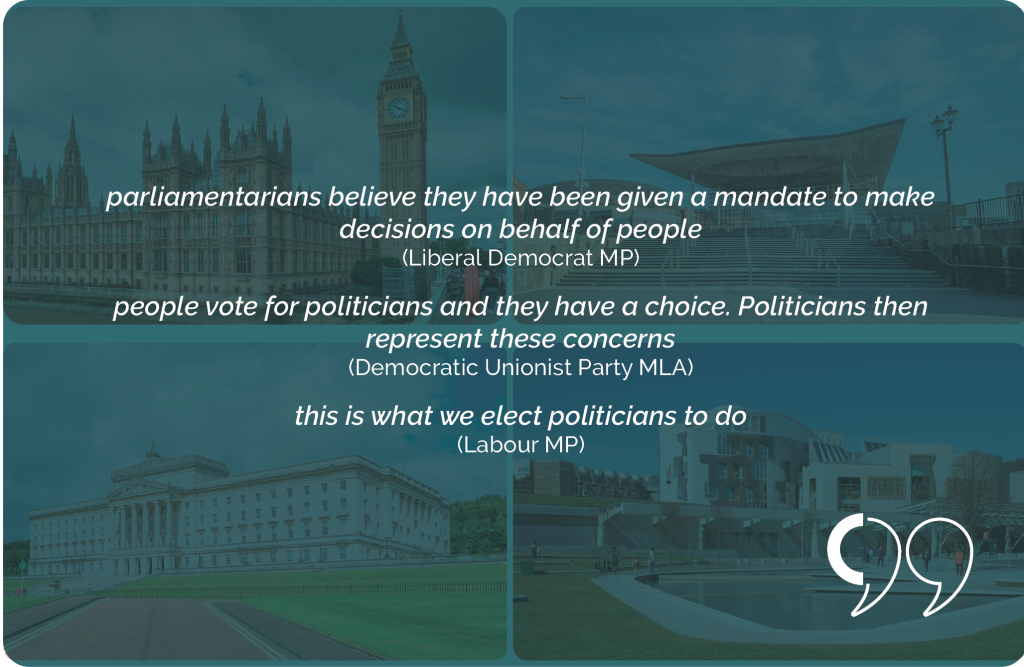
It is notable that for some elected representatives, the idea of using deliberative democracy as a tool to help resolve problems conflicts with their perception of their own role. Several comments suggest that for many elected representatives there is a strong sentiment that resolving entrenched problems is a core part of an elected member’s mandate, without the need for additional deliberative processes. For example:
Duplication of roles
The ideas about the role of an elected member were also reflected in responses to a question asked whether respondents agreed or disagreed that deliberative democratic processes would lead to duplication of elected representatives’ roles. Figure 5 shows the results to this question.
As with many other questions, we see clear differences by jurisdiction. MPs were the most likely to say that deliberative democracy would duplicate the work of elected representatives (45%), followed by MLAs, and then a much lower number of MSPs and then MSs. Indeed, more MSs and MSPs disagreed than agreed that this was the case suggesting less reluctance about this aspect.
On this question, there were fewer clear patterns of response in relation to political party or jurisdiction. While some of the same tendencies emerged again – with three-fifths of Conservative MPs agreeing compared to just over one-third of Labour MPs – this is not consistent across jurisdictions.
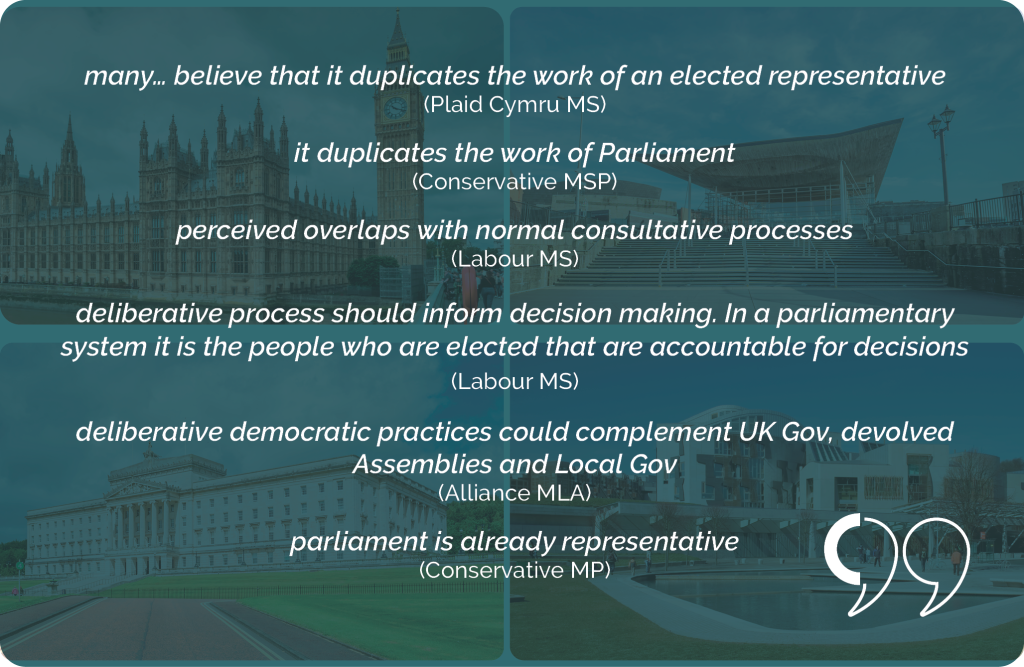
Comments from across the political spectrum raise concerns about the potential duplication between deliberative democracy and the work of elected representatives, although some elected representatives noted the potential for the two processes to work together:
While there were fewer patterns by political party or stance on independence, there was a stronger pattern to suggest that having direct experience of deliberative democracy makes elected officials less likely to agree that it duplicates their work.
Other concerns
Within the survey there were options for open ended responses. Within these, additional themes emerged which can broadly be described as concerns around legitimacy and leadership, or education and evidence. This section shows some of the responses in relation to this that we thought were useful insights into elected representatives’ concerns.
Legitimacy and leadership
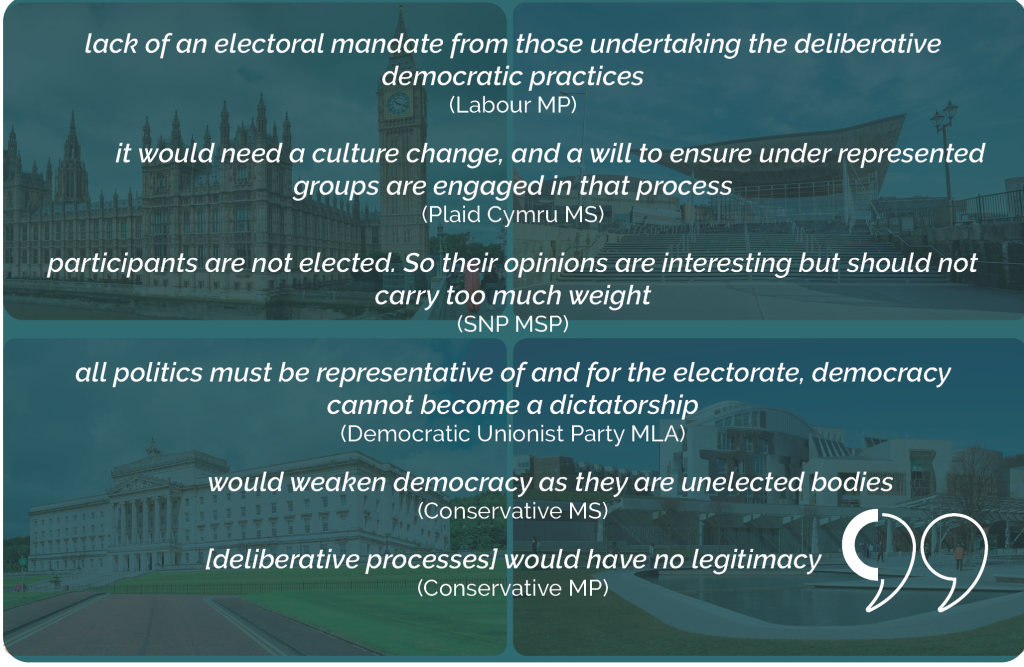
Concerns relating to legitimacy and leadership came from across the political spectrum and across jurisdictions:
Similarly, several elected representatives were concerned that deliberative processes would “undermine” elected representatives, with five individuals using this wording when considering barriers to deliberative democracy.
Education and evidence
In some cases, the concerns expressed by elected representatives indicate differing understandings of what deliberative democracy is and is not. Some elected representatives’ comments show that this limited understanding extends to the evidence base relating to deliberative democracy:
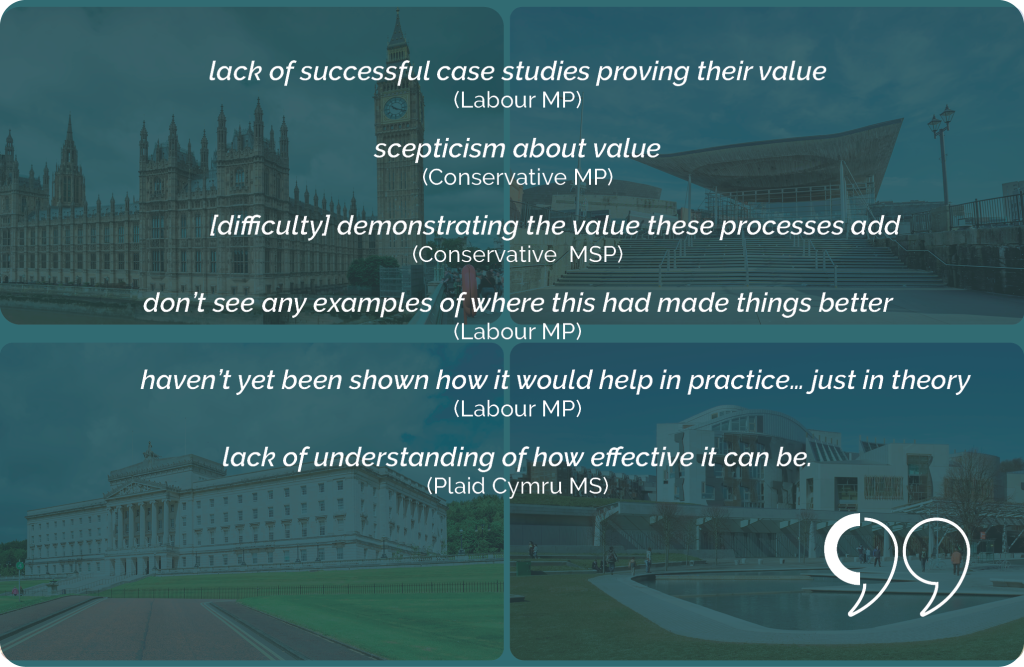
These concerns may reinforce other issues relating to overall trust in and perceptions of the utility of deliberative democratic processes.
Perceptions of capacity
As well as asking about perceptions of deliberative democracy in principle, we asked about the capacity of different institutions (UK Parliament, UK Government, devolved governments or executives, devolved parliaments or assemblies, and local government) to adopt and act on the findings and recommendations of a deliberative democratic process, using a 1 to 10 scale where 1 was ‘not at all’, and 10 was ‘completely’.
Across the board there was a general lack of optimism that any institution could comprehensively take deliberative democratic processes into account and act on findings and recommendations. While each jurisdiction scored institutions slightly differently, there was a relative parity between them.
Within this overall picture, elected representatives in devolved jurisdictions were generally more positive about the capacity of all institutions to adopt processes.
MSPs and MPs agreed that the institution most likely to have capacity to adopt and act on deliberative democratic processes is local government, albeit still only at levels of 39% and 34% respectively scoring this between 7 and 10.
Respondents with previous direct experience of deliberative democracy were slightly more likely than those without to believe that such processes could effectively be adopted. This was especially the case in relation to the capacity of devolved governments and parliaments.
There were also differences according to party affiliation, with left-leaning and pro-independence parties once again more likely to answer more positively. In Northern Ireland, nationalist and other parties were more likely to respond positively than unionist parties. In general, the scores suggest that only a minority of elected representatives have confidence that institutions can adopt and act on findings from deliberative democracy. This is likely to reflect a key theme that arose when asked about barriers to legislatures adopting deliberative processes: resources.
Across jurisdictions, resource and procedure were the most-commonly noted barriers. This related both to time and money, with one MSP noting that “done well, deliberative democracy takes time and detailed input/facilitation” (MSP, Other political party), with concurrent costs attached. One elected member felt that “everybody [is] too busy” (Conservative MS) to adopt these new processes, and another agreed that “logistics and capacity” (Labour MP) were the key barriers.
Besides resources, several elected representatives noted that existing procedures and cultures would be a barrier to the adoption of deliberative processes:
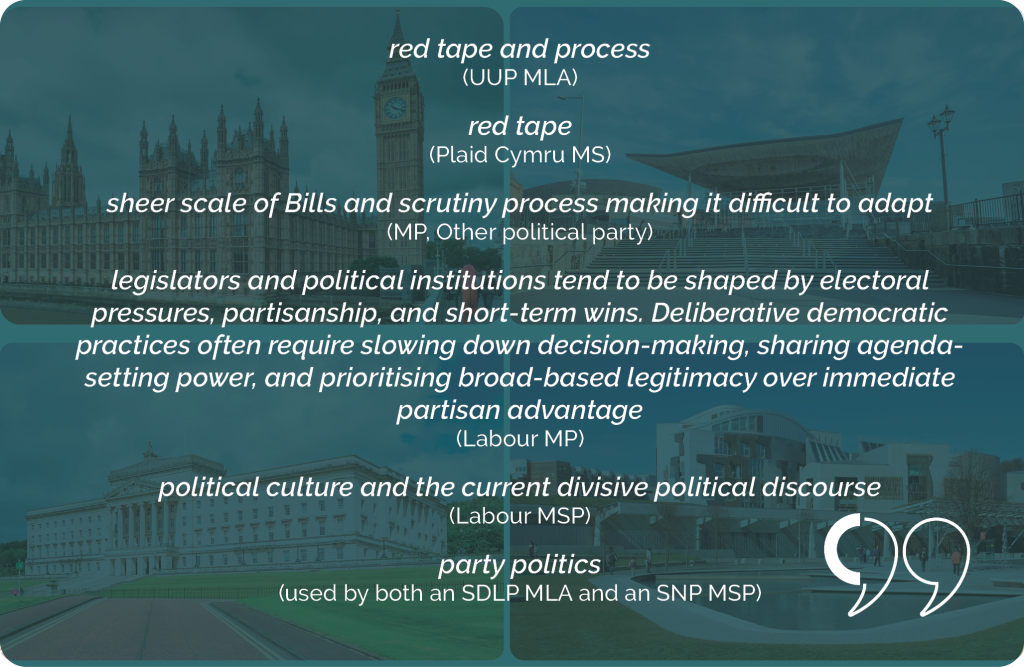
Each of these comments, and others that echo similar sentiments, suggests that many elected representatives believe institutions have limited capacity to adopt deliberative processes without wider-ranging changes to either resourcing or long-standing procedures.
Addressing low public trust in democracy
Given the concerns more broadly about public trust in democracy, we asked two questions relating directly to which institutions should play a role in responding to concerns about public trust in democracy. Figure 7 shows who elected representatives think should play any role in this. Respondents were allowed to choose more than one answer at this question.
There was a general consensus that UK Parliament, UK Government, local government, devolved government or executives, and devolved parliaments or assemblies all have a role to play in responding to these concerns. Elected representatives were most likely to see their own institution as having a role to play in responding to concerns. A small but still significant number of elected representatives said that civil society had a part to play.
Some elected representatives said that none of the institutions listed should have a role in responding to concerns about public trust in democracy.
While elected representatives were very likely to feel that their own institution had a role to play, the same is not true when asked who should have a lead role in this space, indicated on Figure 8. For this question they were asked to give one answer.
MPs were still most likely to select their own institution (UK Parliament), but most elected representatives in devolved jurisdictions gave the lead role to either UK Parliament or UK Government. In all three devolved jurisdictions, elected representatives were more likely to suggest that civil society should take a lead role on these issues than their own parliaments or governments.
Taken together, this suggests that while elected representatives consistently understand that their own institutions have a role to play, they mostly believe that leadership on these issues should primarily be taken centrally by the UK Parliament or UK Government, or even by civil society.
Conclusions and recommendations
Overall, the findings suggest that while current elected representatives across the UK have mixed levels of experience of and some concerns around deliberative democratic processes, there is also openness to their potential. Where resistance from sitting politicians does exist, it is often less about opposition to these initiatives in principle, and more about questions of design, purpose, and capacity. Addressing these barriers is therefore central to realising the potential contribution of deliberative processes to improving democratic wellbeing in the UK.
There are some patterns to suggest that those who have direct exposure to and experience of deliberative processes are less likely to see them as duplicative or threatening although this is inconclusive. What we did see is that scepticism towards these processes is often seen alongside limited understanding of how deliberative processes actually work in practice, uncertainty about how their outputs would be used and doubts about institutional readiness to adopt them.
At Carnegie UK we believe consideration should be given to the following areas to address these concerns:
- Build awareness of deliberative processes among elected representatives: More education about, exposure to, and experience of deliberative processes can reduce concerns from elected representatives about their legitimacy and duplication. Governments and legislatures should look at opportunities for elected representatives to observe and/or engage with these processes as a means of building understanding and trust towards them over time.
- Clarify how deliberative processes can complement and enhance representative decision making: Concerns from elected representatives about mandate, leadership, and accountability of deliberative processes highlight the need for greater clarity about their added value and place in the democratic system. Clearer frameworks and communication from those that support these initiatives should set out more consistently how deliberative processes can support and enhance the work of elected representatives, not undermine it.
- Better institutionalise deliberative processes into existing legislatures: The contribution of all UK parliaments to the democratic wellbeing of the country could be improved by better embedding deliberative democracy into our existing institutions. This would not only help to raise awareness and experience of these processes among elected representatives but would also help parliaments to make better decisions and grapple with complex policy issues while retaining clear distinction of roles alongside traditional representative democracy.
Data tables
The full data tables can be found on Savanta’s website.
Help us make the case for wellbeing policy
Keep in touch with Carnegie UK’s research and activities. Learn more about ways to get involved with our work.
"*" indicates required fields