Hope, fairness and place: a collective wellbeing reading of Andy Burnham’s Makerfield acceptance speech
-

- Hannah Paylor, Carnegie UK
- 23 June 2026
- 4 minute read
During his acceptance speech after the Makerfield by-election, Andy Burnham repeatedly returned to the idea of hope not as a slogan, but as something that has to be rebuilt through the everyday business of government.
That means thinking not only about what government promises, but about how it makes decisions, how it listens, how it works across departments and places, and how it is held accountable for whether people’s lives are actually improving.
Carnegie UK’s work starts from a similar premise: that collective wellbeing should shape the way government is done, not sit alongside it as a separate ambition. It asks whether public policy is rooted in people’s experience, and whether it creates the conditions for people to live well now and in the future.
While it remains to be seen whether other Labour leadership candidates will reveal their own vision for the party and the country, Burnham’s speech can be read as a challenge to the machinery of government itself – to move from short-term fixes and disconnected policy agendas towards a more joined-up, place-sensitive and people-centred way of governing.
Place-first government and the geography of wellbeing
One of the clearest ideas in Burnham’s speech was his commitment to a “place-first” rather than party-first approach. This is important because people don’t feel improvements to their lives through political campaigns or slogans. Rather, collective wellbeing is shaped by the quality of the places people live in, the services they rely on, the opportunities available locally, and whether they feel their community is recognised and invested in.
Evidence from Carnegie UK’s Life in the UK index reinforces this point. It has shown that collective wellbeing has remained stagnant, while inequalities continue to shape people’s experiences of health, housing, income, safety and influence.
Democratic wellbeing and the politics of hope
At Carnegie UK, we know that democratic wellbeing is about more than people turning up to the ballot box. It is about whether people feel heard, respected and able to shape the decisions that affect their lives. Our evidence suggests this remains one of the weakest areas of collective wellbeing in the UK, with many people feeling distant from the institutions that are meant to represent them.
This was echoed powerfully in our recent Poverty Truth work, where people argued that accountability is central to rebuilding trust. It also came up repeatedly in our work on Engaging Democracy, where we found that building a stronger working relationship between parliamentarians and citizens can increase institutional capacity.
This is why Burnham’s language of hope could be significant. In the speech, hope was not presented as optimism alone, but as something that has to be built through a different relationship between people and politics: one based on listening and a commitment to govern for everyone, not only for those who already feel represented.
Taken together, Burnham’s speech maps closely onto the four domains of Carnegie UK’s vision for collective wellbeing:
- Social wellbeing: we all have the support and services we need to thrive. Highlighted through the discussion of the need to rebuild hope, community pride, and cohesion.
- Economic wellbeing: we all have a decent minimum living standard. Evident in the discussion of addressing the cost of living.
- Environmental wellbeing: we all live within the planet’s natural resources. Demonstrated through references to the need to focus on the lived experience of local areas.
- Democratic wellbeing: we all have a voice in decisions that affect us. Themes of restoring trust, voice, and participation were mentioned throughout.
From a political moment to governing for wellbeing?
Andy Burnham’s framing of Makerfield as a “turning point” suggests more than political change. It points to an opportunity and aspiration to govern for wellbeing, where success is judged by whether government delivers improvements to people’s lives over time. This must include new methods, mechanisms and models of governing for wellbeing.
Carnegie UK argues that improving collective wellbeing should be the primary goal of public policy. Burnham’s message – grounded in hope, fairness, and place – offers a political narrative that could support that shift. As he is sworn in as the new MP for Makerfield and with news this week that Keir Starmer will shortly step down as Prime Minister, the key test will be whether over time these ideas move beyond a narrative and translate into a way of governing that improves people’s lives in practice.
At Carnegie UK we have a growing body of evidence, insight and case studies to show how this can be done.
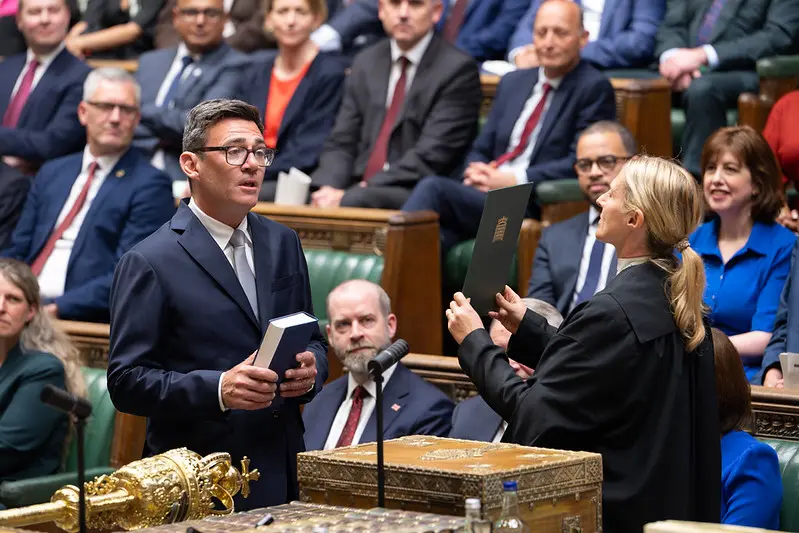
Header image shows Andy Burnham MP (Makerfield) during the swearing in of new Members of Parliament on 22nd June 2026. Picture by House of Commons on Flickr.
Help us make the case for wellbeing policy
Keep in touch with Carnegie UK’s research and activities. Learn more about ways to get involved with our work.
"*" indicates required fields