
- Democracy
- Government and public services
- Professor Oliver Escobar (University of Edinburgh) and Professor Stephen Elstub (Newcastle University) for Carnegie UK
- 28 May 2026
- ISBN: 978-1-917536-09-7
- 75 minute read
Executive summary
Context and purpose
Democratic wellbeing means people having voice and choice over decisions that affect their lives. Strengthening parliamentary democracy is essential for improving democratic wellbeing in the UK. This paper supports current efforts to enhance the UK’s four parliaments through deeper public engagement and citizen deliberation. Building a stronger working relationship between parliamentarians and citizens can increase institutional capacity to address the challenges of our time.
Parliaments are expected to navigate complex, long-term and often contentious policy challenges, while maintaining public trust and demonstrating responsiveness to citizens. Yet existing mechanisms for engaging the public in parliamentary policymaking – consultations, surveys, lobbying – often struggle to provide the kind of considered public judgement these challenges require
Why mini-publics?
We focus on mini-publics because they provide a robust and practical way to embed citizen deliberation in legislatures. Mini-publics are civic forums in which a diverse cross-section of the public participates in evidence-based deliberation to inform decision-making. Participants are selected through civic lottery to reflect the wider population and supported with resources to reduce barriers to participation.
These features distinguish mini-publics from engagement where self-selection often advantages those with the time, resources, or motivation to participate. When well designed, mini-publics can help address the disconnect between citizens and institutions by enabling people to engage with complex issues, weigh trade-offs, and contribute to decision-making. They bring lived experience and practical judgement into the policy process – not as a substitute for representative democracy, but as a way of strengthening it.
Why parliaments?
In democratic systems, parliaments play a pivotal role in debating and legislating on the key issues of the day and scrutinising the activities of government whilst representing the public. Across the UK, there is already significant momentum towards deeper public engagement with legislatures to enhance their ability to fulfil these functions. However, much of this activity remains consultative rather than deliberative, episodic rather than systemic, and reliant on organised intermediaries rather than the considered judgement of citizens. The result is a landscape that is active but fragmented, innovative but uneven, and still falling short of its potential.
Mini-publics can address these gaps. They add capacity to legislatures by providing high-quality insight into complex policy questions, strengthening public mandates and decision-making. As policy challenges grow in range and complexity, they offer a way to expand the democratic infrastructure available to parliaments.
In this context, mini-publics have gained traction in the UK and internationally, informing decisions from climate change to constitutional reform. However, most remain one-off or ad hoc exercises. Their impact is therefore uneven, dependent on political will and often limited in scope. The key challenge now is how to embed them more systematically.
Why institutionalisation?
We focus on mini-publics because they provide a robust approach to embed citizen Institutionalisation would embed mini-publics within parliamentary rules and procedures and strengthen parliaments’ listening capacity. This is ultimately about supporting parliamentarians by providing the infrastructure needed to work more effectively with citizens, deepen representation, and improve policy outcomes. It is a long-term investment in the resilience, responsiveness and legitimacy of democratic institutions.
It also matters for integrity. To play a meaningful role, mini-publics require the stability, recognition and protection that formal structures provide. Embedding them within parliamentary systems reduces the risk of tokenism or neglect and helps ensure that their work is taken seriously and used consistently. Where they are well designed and connected to decision-making, mini-publics can:
- improve the quality of public reasoning available to policymakers;
- place citizens’ values, priorities and lived experience at the heart of decision-making;
- increase problem-solving capacity;
- help anticipate public concerns and identify workable trade-offs;
- build informed public support for difficult decisions;
- reduce the risk of policy reversal or backlash;
- and renew the connection between citizens and parliamentarians.
Mini-publics should therefore be understood as part of the infrastructure of effective governance, rather than as an optional add-on. Their value lies not only in improving deliberation, but in helping decision-makers act with greater confidence, authority and credibility.
Citizens empower their representatives at the ballot box, but the complexity of contemporary governance requires ongoing engagement. Mini-publics can extend this relationship into parliamentary work, empowering representatives with ongoing insight for collective action.
At the same time, they are not a silver bullet. They should be understood as one component of broader reforms to strengthen democratic capacity across institutions and society. On their own, they cannot resolve persistent challenges such as low trust, unequal participation, or limited state capacity. But bringing citizen deliberation into parliament may act as a catalyst to drive wider and deeper changes towards democratic wellbeing.
Blueprints for Institutionalisation
The report introduces four blueprints for embedding mini-publics in UK legislatures. They illustrate options that can be adapted to the differing infrastructures and cultures of each parliament
- Mini-publics on Demand – convened at the request of parliamentarians, supported by procedural rules and dedicated staff.
- Mini-publics Initiated by Public Petition – triggered by petitions reaching a threshold, linking participatory and deliberative mechanisms.
- Citizen Council and Themed Mini-publics – a standing citizen body working alongside issue-specific mini-publics throughout the parliamentary cycle.
- Second Chamber – a lottery-based second chamber, representing the most far-reaching form of institutionalisation.
These blueprints are not mutually exclusive; they represent points along an evolutionary pathway. Parliaments may begin with lighter-touch approaches and develop more embedded forms over time, as experience, capacity and public support grow.
While the focus is on parliaments, the effectiveness of these blueprints depends on their relationship with government, local institutions and wider society. In practice, institutionalisation requires a system-wide approach: connecting national-level processes with local participation, building the capacity of public institutions, and creating clearer pathways from deliberation to decision-making and implementation.
The report addresses questions about authority, accountability, governance, infrastructure and leadership. It concludes that institutionalising mini-publics is both desirable and feasible, but contingent on key enabling conditions. These include political leadership, institutional capacity, broader public engagement, and a commitment to democratic renewal across society.
We conclude with a call to action. Embedding mini-publics is a practical way for today’s leaders to improve policy and outcomes for people, renewing the relationship between citizens and their parliaments, and thus strengthening democratic wellbeing now and for generations to come.
Key messages

The time for action is now. Democracy in the UK is under strain from declining trust, polarisation, short-termism, misinformation and disinformation, and a growing gap between institutions and citizens. Delay risks further erosion.

Action is feasible. Mini-publics are no longer experimental. There is substantial experience to draw on, and foundations exist within UK legislatures. The UK is well positioned to lead internationally.

There is no single way of doing this. Institutionalisation can take different forms depending on political context, capacity and purpose. The blueprints illustrate pathways, but reforms must be shaped by people with a grounded understanding of local context and what it takes to deliver change.
Introduction: Purpose and Context
Democratic wellbeing means people having voice and choice over the decisions that affect their lives. Strengthening parliamentary democracy is essential for improving democratic wellbeing in the UK. Building a stronger working relationship between parliamentarians and citizens can increase institutional capacity to address the challenges of our time.
This paper supports current efforts to strengthen public engagement and citizen deliberation in the four UK parliaments. It presents blueprints for institutionalising citizen deliberation. We call them ‘blueprints’ because they lay foundations to build institutions for the future, but they are not intended as rigid designs. The blueprints adapt well-known forms of citizen deliberation for diverse parliamentary purposes and contexts.
The paper has three aims:
- It makes the case for embedding citizen deliberation permanently in UK legislatures to improve policies, decisions and outcomes.
- It introduces four blueprints, considering options and trade-offs for the institutionalisation 1 of citizen deliberation.
- It outlines practical considerations to embed mini-publics across parliament, as part of broader efforts to improve democratic wellbeing in the UK.
What are mini-publics? Are they a good fit for parliaments?
Mini-publics are forums that involve a cross-section of the public in evidence-informed deliberation to inform decision-making. Participants are selected through civic lottery (aka ‘sortition’) to reflect the diversity of the population in demographics and viewpoints and supported with resources to reduce barriers to participation (e.g. compensation and expenses).2
These features make mini-publics very different from public forums where self-selection gives an advantage to those most likely to volunteer or who can afford to do so. In contrast, mini-publics typically include people who do not usually have the opportunity to participate directly in shaping the decisions that affect their lives. In this way, mini-publics contribute to address the growing ‘participation gap’ that separates the ‘politically rich’ and the ‘politically poor’ in our societies.3
We focus on mini-publics because they provide a robust approach to embedding citizen deliberation in legislatures. With a track record of five decades, research on mini-publics shows that they can:4
- attract a diverse cross-section of the population,
- address all kinds of complex issues,
- examine wide-ranging evidence,
- find common ground and overcome political deadlock,
- engage productively with differences, conflict and trade-offs,
- and agree conclusions motivated by public interest.
Mini-publics provide additional support to existing decision-making processes and can help to strengthen public mandates to address policy problems. As parliaments and elected representatives face mounting workloads on an ever-growing number of public issues, mini-publics bring additional capacity to legislatures. They can support, complement and deepen the work of parliamentarians by expanding and strengthening the infrastructure for deliberation, problem-solving and decision-making.
Parliamentarians are already adept at collaborating and delegating to get things done, for example, via committees, commissions, inquiries, task groups, advisory bodies and so on. Mini-publics provide a citizen-centred, evidence-informed and public-spirited mechanism for task delegation that can help parliamentarians to share their duties and fulfil their mandates.
Why should UK legislatures lead the way?
Experiences of mini-publics across the UK in the last three decades provide evidence and the foundations to support their institutionalisation.5 The UK has, at key moments in history, taken the lead in developing and upgrading democratic institutions. This paper argues that it is time to do so again.
We are living through a period of epochal change, and our core institutions need reinforcement. Parliamentary democracy has endured because it has evolved. As people and societies change, democratic institutions must change with them. The question today is what form that evolution should take.
A key role of our parliamentarians is to listen in order to lead and represent. Yet the listening architecture at their disposal is increasingly unfit for purpose. They have to make sense of a skewed and fragmented picture of public opinion, triangulating between headlines in traditional media, bursts of social media outrage, claims by organised interest groups, and the myriad demands of constituency casework. What they rarely get is the opportunity to engage with considered public views: the reasoning behind headline positions, the trade-offs people are willing to make, and the options that emerge when citizens engage with evidence and deliberate with one another.
This is not only a deficit of participation, but a deficit of decision-support. When institutions lack access to considered public judgement, they are more vulnerable to short-term pressures, reactive policymaking, and costly policy reversals. The question is therefore not simply how to listen more, but how to listen better in ways that support effective governance.
This raises a simple question: do elected representatives have the tools needed to engage a cross-section of the public in supporting parliamentary work? At present, most approaches available – e.g. polls, petitions, consultations, constituency surgeries, door-step conversations – offer only partial insight. What is missing is ongoing deliberative insight: structured, inclusive, experiential and evidence-based engagement that broadens the range of views considered and deepens the quality of policy deliberation.
This is why institutionalisation matters. Mini-publics organised ad-hoc already provide high-quality spaces for public reasoning, but their value and contribution can be improved with the standing, integrity and protection that institutionalisation brings. Embedding them within legislatures, according to clear rules and procedures, reduces the risk of manipulation, tokenism or neglect. It creates stability, allowing citizen deliberation to bed in and become part of how parliaments work.
This is ultimately about supporting parliamentarians with new infrastructure for working with citizens – deepening representation by generating new power for collective action and thereby strengthening decision-making and policy outcomes. It is about institution-building and long-term thinking: ensuring that parliaments are resilient, connected and responsive in a rapidly changing world. In sum, it is about improving democratic wellbeing in the face of the current democratic recession.
Is there really a global democratic recession?
For over two decades, every major global index has told the same story: democracy is backsliding around the world. Research institutes and democracy observatories have documented a sustained period of democratic recession marked by public dissatisfaction, growing authoritarianism, dwindling civic space, rising polarisation, and declining trust in political institutions.6 Fewer people now live in democracies than in autocracies, while democracies with robust rights protections and checks and balances are becoming the exception rather than the norm.7
Even countries once considered firmly democratic are not immune. In Western democracies, including the UK, public dissatisfaction has deepened and confidence in political institutions and elected representatives has reached historic lows.8
The perception that democratic politics is not delivering for people is corroding legitimacy across systems that previously seemed stable. Crucially, the democratic recession is not just about indices and rankings: it shapes everyday life. When trust erodes, effective social cooperation becomes harder:
- Citizens withdraw or turn to cynicism, anti-establishment sentiment or authoritarian populism.
- Institutions struggle to secure legitimacy for difficult policies and decisions.
- Social cohesion weakens and polarisation hardens.
- Public deliberation becomes shallow debate, less focussed on the public interest and on problem-solving.
For many, the loss of faith in democracy’s capacity to deliver contributes to anxiety, alienation, and a sense of powerlessness. Younger generations are especially sceptical.9 An increasing number of people doubt that democracy, as it is practiced today, can make a meaningful difference to their lives and communities. These are warning signs of deeper democratic malaise – symptoms of a system failing to update itself for contemporary realities.
Yet the story is not only one of decline. Across the world, democratic innovation is emerging as a practical response to this crisis.10 Public institutions and civil society organisations are developing new forms of public engagement and citizen deliberation. The aim is not simply to defend parliamentary democracy, but to strengthen it for the times ahead.
How is the UK doing on democratic wellbeing?
The UK remains a stable democracy, but many people think that it doesn’t work for them. Carnegie UK’s Life in the UK 2025 index indicates that 72% of people do not feel they can influence decisions – a figure that has remained unchanged over the three years of the study. This persistent sense of powerlessness feeds into widespread disengagement and low trust in political institutions.
Carnegie UK’s research on democratic wellbeing examines whether people feel they have voice and influence in the decisions that shape their lives. It is a citizen-centred measure that encompasses trust, participation, a sense of efficacy, and perceptions of fairness. By this measure, the UK faces a significant deficit in democratic wellbeing, although perceptions vary across different segments of the population.
People with higher household incomes and those living in less deprived areas express greater trust and a stronger sense of influence. Older adults report higher democratic wellbeing than younger generations. Conversely, disabled people and those living in social housing continue to feel least able to influence and trust institutions.
These inequalities reveal a disconnect between citizens and political institutions, and a growing divide between the ‘politically rich’ and the ‘politically poor’.11
This picture is echoed across other sources. Recent research finds that nearly half of UK citizens believe none of the political parties represent them.12 Low trust, low perceived efficacy, and growing openness to undemocratic alternatives signal a democracy under strain.
Yet democratic wellbeing is not an abstract ideal or just a matter of perception. It is the fabric of a functioning society. When people feel they have voice, choice, and influence, institutions gain trust and stability, public legitimacy for complex policy change is easier to build, and collective action becomes possible. When democratic wellbeing is low, these enabling conditions are undermined. A deficit in democratic wellbeing is both a symptom and a driver of wider social problems – from polarisation to policy paralysis.
Carnegie UK’s Life in the UK index notes that democratic wellbeing is as vital as economic or social wellbeing. It is intrinsically valuable: in a democracy, people must have a meaningful say in decisions that affect them. It is also instrumentally valuable: effective governance in a complex society depends on public legitimacy and cooperation. Improving democratic wellbeing requires institutional innovation and renewal. The symptoms of malaise point directly to the remedies: we need better, more meaningful ways for people to contribute to public decisions, and institutions that embed public engagement.
Evidence from the UK and globally shows that citizen deliberation via mini-publics can make a difference.13 Participants frequently report a stronger sense of political efficacy, better understanding of issues, and increased trust – provided the process is inclusive, deliberative and connected to decision-making.14 However, where citizens’ contributions are ignored or instrumentalised, trust can deteriorate further. The careful design and institutionalisation of mini-publics therefore matter greatly.
Under the right conditions, these democratic innovations can help repair the disconnect by enabling citizens to generate ideas, deliberate complex trade-offs, and support the work of elected representatives. They can bring the lived experience and practical wisdom of the public not as a substitute for parliamentary democracy, but as a way of strengthening it.
How does public engagement in UK parliaments currently work?
Across the UK, there is significant momentum toward deeper and more meaningful forms of public engagement.15 Each of the four parliaments has recognised that public input must be broadened, diversified, and better integrated into their everyday work, and they currently employ a range of engagement channels.
Petition systems give citizens a direct route to suggest issues for debate. Written and oral evidence to select committees bring expert voices and stakeholder input into scrutiny. Public consultations (e.g. online calls for submissions, surveys, dialogues) invite broader public opinion on legislation. Educational programmes, outreach events, and school visits raise awareness of parliamentary work. And of course, parliamentarians’ local surgeries and casework keep representatives connected to some of their constituents. Each of these channels has value: they give access, gather information, and promote public understanding of legislatures. However, there is recognition that these tools alone are not enough.
The Scottish Parliament has experimented with participatory initiatives that treat citizens not simply as consultees but as partners in shaping parliamentary work. Wales and Northern Ireland have also moved towards better public engagement, investing in capacity-building and relationship-building with civic actors. Westminster parliamentary committees have expanded the use of advisory panels, digital engagement methods, and targeted public dialogues that seek to bring lived experience into legislative processes. Across these institutions there is a shared recognition that public engagement matters.
Yet this progress has been limited. Much of the engagement currently undertaken is consultative rather than deliberative; episodic rather than systemic; reliant on organised intermediaries rather than the considered judgement of lay citizens.
While committees are increasingly using new methods, these often struggle to include a cross-section of the public or to support the learning and deliberation needed for citizens to address difficult issues and trade-offs. In short, the parliamentary public engagement landscape is active but fragmented, innovative but uneven, and promising but still falling short of its democratic potential.
This is where mini-publics offer a new way of institutionalising inclusive and informed public reasoning. We are not arguing to replace current public engagement, but to add a capacity that is missing: the ability of citizens to engage in high-quality deliberation that complements the work of parliamentarians. Rather than supplanting representative structures, mini-publics can enrich them by identifying public values, assessing contested evidence, discerning priorities, and generating solutions that elected members can carry forward. This can strengthen the connection and feedback loop between people and parliament, and increase the power of representatives to act effectively.
The value of mini-publics lies in complementing electoral representation with deliberative insight. The underlying theory of change is threefold. First, mini-publics can improve the quality of public reasoning available to decision-makers. Second, when visibly integrated into decision-making, they can strengthen public trust in legislatures and enhance their legitimacy. Third, over time, they can reshape the incentives and practices of parliaments by embedding more deliberative and inclusive ways of working. As a result, policies and decisions are more likely to reflect people’s lived realities, command broader support, and be more implementable – thus leading to better outcomes. However, as later noted, these effects depend on institutional capacity, political leadership, connections across governance systems and broader reforms towards democratic renewal.
The UK already has foundations to be a global leader in this field.16 What is needed is a shift from experimentation to institutionalisation: moving from ad-hoc projects to a coherent architecture of citizen deliberation that is embedded, resourced, and purposefully connected to parliamentary work.
The case for institutionalising citizen deliberation in parliaments
The contribution of all UK parliaments to the democratic wellbeing of the country could be improved if parliamentary deliberation was supplemented with citizen deliberation. Mini-publics can enable parliaments to obtain practical policy recommendations from a diverse and informed cross-section of the public that parliament would not otherwise hear from. This can improve legislation and scrutiny and increase trust between citizens and their parliaments. These benefits have led many legislatures in Europe and the UK to convene mini-publics. Institutionalising mini-publics would maximise the benefits by ensuring they are regulated and governed by parliamentary rules and become a permanent channel for public engagement.
Deliberative democracy is an approach that prioritises the communication that precedes decision-making. According to deliberative democrats, this communication should be inclusive, reasoned, public-spirited, and respectful. Beyond providing a fair decision-making procedure, deliberation is seen to improve the quality of decisions by encouraging careful reasoning and by orienting collective action towards the public interest. In order to promote democratic wellbeing, deliberation should therefore be embedded wherever important political decisions are made such as within cabinets, parliaments, and political parties.
Moreover, democratic wellbeing also requires citizens to be included in deliberation. This enables politicians to hear citizens’ views, problems, and aspirations along with justified proposals on how these could be effectively addressed. In addition, including citizens in deliberation increases the range of views, experiences and information that can be considered in advance and consequently improve decision-making. In turn, politicians would have the opportunity to justify the decisions they do make to the public.
However, there are many challenges in engaging the public with parliaments. Structural inequalities in gender, class, ethnicity and level of education lead to skewed political participation.17 When people discuss political issues with each other, they gravitate to people like them who hold similar views.18 Their opinions are therefore frequently confirmed and not challenged, leading them to hold those views even more strongly.
Mini-publics have become a well-established approach to addressing these challenges. They resemble legal juries but for policy and politics. There are different types, with variations in size, duration, and activities, but they share some common features.19
- Firstly, citizens are selected quasi-randomly in a civic lottery, which seeks to give everyone an equal chance of being selected. A quota system is used to ensure that the participants are diverse and reflect a cross-section of the public in relation to key demographics like age, gender, race, ethnicity, geography, income, and education, as well as the spectrum of viewpoints on the topic for deliberation. Financial support for participants is provided to cover time, travel, accommodation, and care costs. This encourages citizens who do not usually engage politically to participate and avoids domination by those who can afford to participate.
- Secondly, once assembled, the citizens are provided with balanced information including evidence and a range of perspectives on the issue they are considering, usually provided by expert and advocate witnesses. There are opportunities to scrutinise the evidence, testimonials, and arguments presented.
- Thirdly, this information and the views of the citizens are discussed in impartially facilitated sessions to promote inclusive, reasoned, and respectful deliberation, where participants can explore and address conflicting perspectives and policy trade-offs.
- Fourthly, participants agree a set of recommendations. Due to the process through which the recommendations are formed, drawing on expertise and experience, the recommendations tend to be well-informed and actionable. This also means that mini-publics move us beyond consultation and promote democratic wellbeing by enabling citizens to directly influence debates and decisions.
- Finally, the recommendations are fed into the policy and legislative process. For example, they can be considered and debated in the committees and chambers of parliament, along with other options that we explore below.
What can citizen deliberation do for parliaments?
Mini-publics can bring many benefits to the deliberative and legislative processes already present in parliaments. As noted in Section 1, parliaments across the UK do regularly engage with the public, but it often falls foul of the skewed nature of political participation, which is either passive and uninformed or mobilised by resourceful interests, partial or biased.20
Build trust:
- Citizen deliberation in parliament can help rebuild trust between legislatures, parliamentarians, and their constituents.
- Trust in political institutions, parliament and elected representatives is low and declining in the UK.
- Citizens want to have more voice, choice and influence in decision-making and they do not think that their parliaments currently provide this.21
- In many typical public meetings elected members are addressing mainly vociferous, discontented, and confident members of the public.
- In contrast, whilst each mini-public only involves a small number of citizens, everyone has an equal chance of being selected; participants reflect a cross-section of the population regarding demographics and views; and they have access to evidence about the issues being considered.
- Mini-publics are therefore seen as more trustworthy by both parliamentarians and the public at large.22
- Parliaments as whole institutions can benefit from this increased trust of doing politics differently, and individual parliamentarians associated with the process can gain electoral credit from their constituents, especially if they have afforded the mini-public a degree of influence.
Considered opinion:
- While parliaments already consult the public in a variety of ways (see Section 1), the limitations of those processes means that the views gathered can be partial, fragmented, or unconsidered.
- The mini-public process allows citizens to engage with diverse evidence and perspectives on the issue.
- As a result, the consensus view achieved through a mini-public can be more valuable to inform parliamentary work than individual opinions.
Balanced perspective:
- Another limitation of the public engagement methods currently used by parliaments is that they tend to hear from the most interested, resourceful, and organised.
- The mini-public approach ensures that the resulting recommendations have been produced by a diverse group that includes a genuine range of values, perspectives, and experiences.
- These recommendations can therefore provide more deliberative value than those presented to parliament by groups that are neither diverse nor supported to deliberate alternative options and their trade-offs.
New ideas:
- Involving diverse citizens in a process of genuine deliberation means that mini-publics can provide parliament with new information, ideas, and perspectives that elected representatives would not otherwise have access to.
In sum, mini-publics can support parliamentarians to make better decisions, and listening to these citizens can be popular with the wider public. They are a practical way in which parliaments can upgrade their deliberative capacity and contribute to broader democratic wellbeing.
Approaches to citizen deliberation in parliaments across Europe
Parliaments across Europe are starting to use mini-publics to engage citizens on important issues. This is happening in various ways as highlighted in Table 1.
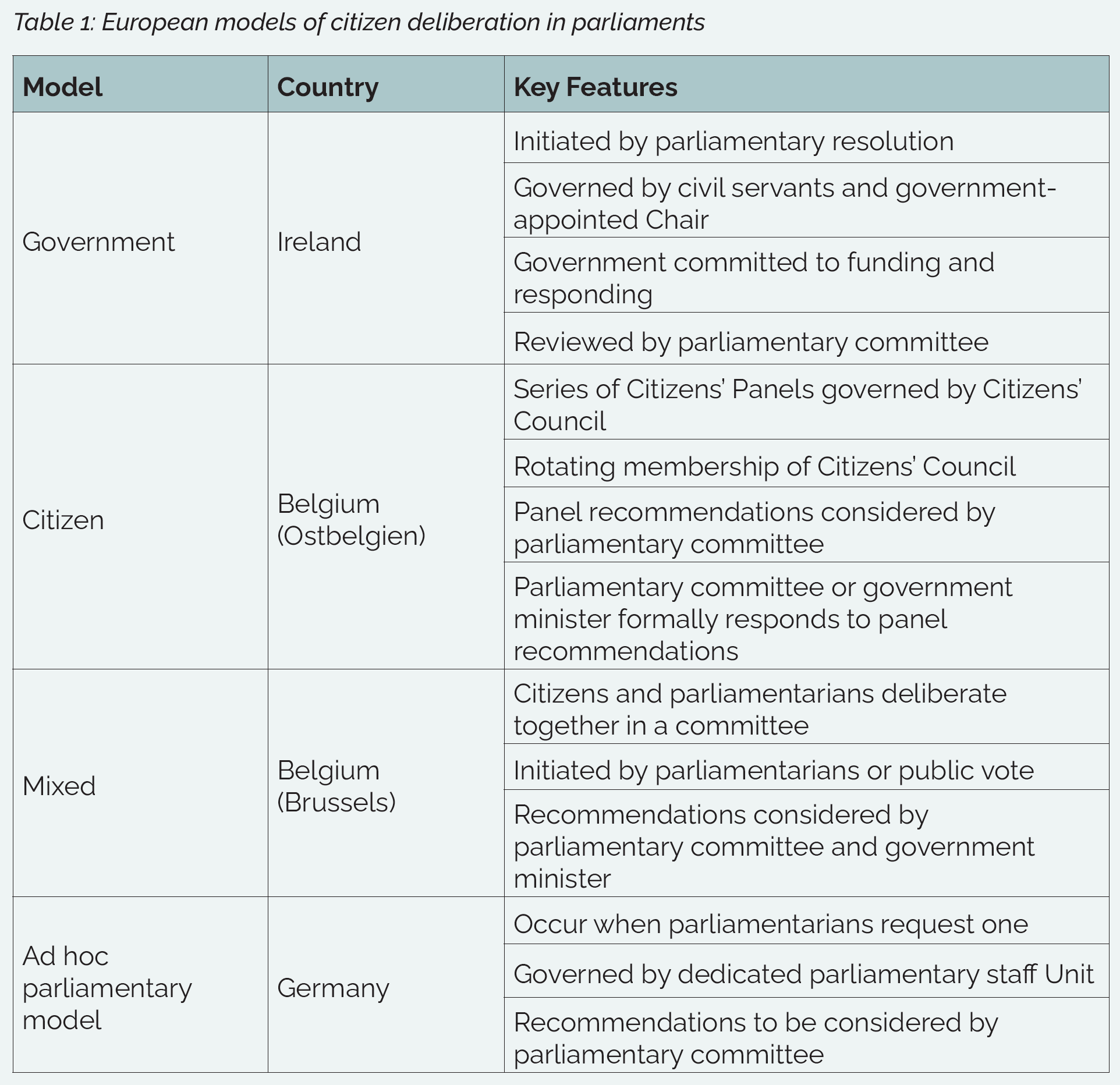
Government model. The mini-public is connected to parliament, but the process is led by the government, who decides when a mini-public should happen, on what issues, in which format, and with what funding. Ireland is a good example of this approach. A permanent citizens’ assembly in Ireland was established by a parliamentary resolution in 2016. There is a Secretariat, appointed by the government, that recruits an Advisory Group and runs the process in collaboration with a Chair. This is usually a civil servant seconded from the Prime Minister’s Department and they chair the debates, help the Secretariat in running the process, and present the report at the end.
The parliamentary resolution commits the government to fund the citizens’ assembly and to review and respond to the recommendations in parliament. A committee of both houses has been set up to review the citizens’ assembly reports. The government must provide a formal response within six months of receiving the recommendations.23
Citizen model. Here government and parliament have less control over the mini-public, in favour of more control by citizens. The Ostbelgien Parliament in Belgium is a good example of this approach. In 2019, it established a permanent mini-public to determine an ongoing agenda for issue-focused, short-term citizens’ panels. The permanent Citizens’ Council, comprised of 24 citizen councillors governs the citizens’ panels. Two thirds of citizen councillors are selected by lottery from the general public, and one third are randomly recruited from previous citizens’ panels. Each citizen councillor serves an 18-month term with a third of those on the Citizens’ Council replaced every six months.
The Citizens’ Council initiates up to three citizens’ panels per term and determines their remit, timing, size, duration, and budget. It appoints moderators for the process and the advisory committee that oversees the panel and determines the recruitment and stratification process. The Citizens’ Council also provides oversight of the Parliament and government response.
The recommendations are then discussed three times by a joint committee, comprising a combination of mini-public participants, members of parliament, and the relevant government minister. Depending on the relevance of the recommendations, either members of a parliamentary committee or the government minister provide a formal response explaining how they will implement the recommendations or why they are not being implemented. A year later, a third joint committee reports on progress of the implementation.24
Mixed model. In this approach citizens and parliamentarians are brought together to deliberate and decide on recommendations, with both groups having some control over the process. The parliament of Brussels is a good example. Since 2019 the Parliaments of Brussels-Capital Region (BCR) have held mixed deliberative committees combining elected representatives and members of the public. The mixed committees are initiated either by parliamentarians or the public. The latter route requires the support of a minimum of 1,000 residents of Brussels. Votes can be cast via the parliamentary website.
However, the final decision on whether to set-up a mixed committee lies with the elected chamber. Each mixed committee is comprised of 12-15 parliamentarians (members of the corresponding thematic standing committee) and 36-45 randomly selected residents of Brussels. The report and recommendations must be considered by the corresponding permanent parliamentary committee, and the relevant government minister is required to explain the committee’s response to the recommendations within six months. The applicable parliamentary committee also gives a formal account to parliament and the citizens within nine months of receiving the recommendations.25
Ad hoc parliament model. Here elected representatives have control over the process and mini-publics proceed in an ad hoc fashion, occurring as and when parliamentarians think the process will be useful. The Bundestag (Germany’s federal parliament) is an example of this approach to mini-publics. In 2023/4, they held a citizens’ assembly on nutrition, a topic selected by parliament, with the assembly recommendations being considered by the Bundestag’s Committee on Food and Agriculture. However, the Committee ran out of time to do so before the unexpected election in February 2025.26 A Citizens’ Assembly staff unit had been set up within the parliament to organise mini-publics, but this was recently dissolved by the Bundestag president.27
Approaches to citizen deliberation in parliaments across the UK
Mini-publics have also been convened by parliaments in the UK.
UK Parliament: A select committee decides that it would benefit from convening a mini-public on a particular topic. It then releases a call for tenders, and an external organisation is appointed to organise the mini-public. Two citizens’ assemblies have been commissioned so far, one on adult social care funding in England (2018) and another on reaching net-zero carbon emissions (2020). A third citizens’ assembly on legal immigration is planned for 2026.
The recommendations from the mini-publics feed into select committee inquiries, either current or newly instigated. Findings have also been debated in the House of Commons.28
Scottish Parliament: Since 2019, the Scottish Parliament has organised a series of mini-publics, called People’s Panels, to support the committee system. There is a permanent Participation and Communities Team (PACT) tasked with organising the mini-publics, including session design and facilitation. PACT deals with all aspects of the mini-public except the participant recruitment, which is outsourced to a specialist firm. They also liaise with the parliamentary committee that has requested the mini-public, advising it on suitable topics and how the mini-public can feed into committee inquiries and other work.29
The Scottish Parliament have held six People’s Panels so far on a range of topics and is now looking to embed them permanently, including changing the standing orders and developing a blueprint for institutionalisation.30
Senedd Cymru: The Welsh Parliament has engaged with citizens’ assemblies, notably in 2019 when the Citizens’ Assembly for Wales addressed the question ‘How can people in Wales shape their future through the work of the National Assembly for Wales?’. The design and organisation of the assembly was outsourced to an external organisation.31
More recently, the Independent Commission on the Constitutional Future of Wales (2024) has expressed support for the use of mini-publics as part of broader efforts towards democratic renewal.
Northern Ireland Assembly: Mini-publics are not new to Northern Ireland, but they have historically been organised by civil society organisations and academics rather than the legislature. In 2020, the New Decade, New Approach agreement brokered by the UK and Irish governments to restore Stormont included a commitment to integrate mini-publics into policymaking, but the Northern Ireland Assembly has not yet implemented it.
Recently, a wide coalition set up the ‘Civic Initiative’ to test and advance the use of mini-publics. This included establishing a Citizens’ Forum on Housing, followed by opinion polling that indicated public support for the use of mini-publics in the Northern Ireland Assembly.32
The case for institutionalising mini-publics in parliaments
Parliamentarians increasingly value the deliberative and participatory qualities of mini-publics and as a result we are seeing more parliaments convening them across Europe and the UK.33 Institutionalising mini-publics would strengthen their benefits to parliamentarians, parliaments, and to democratic wellbeing. By institutionalisation we mean the process through which mini-publics would gain value and stability in parliament.34 There would be rules and procedures on when mini-publics should be instigated, how they are governed and funded, and what the follow-up from parliamentarians should be. They would become part of parliamentary culture. Institutionalisation would bring benefits to the parliament, the mini-public, and the public.
Firstly, trust between parliament, the mini-public and the public would be enhanced. Parliamentarians would get to witness and receive recommendations from citizens working under good conditions to become informed, deliberate and address trade-offs. Over time, parliamentarians will likely have increased trust in the everyday citizen to get involved in politics in a meaningful way and shape policy. Mini-public participants would gain a greater insight into the tough choices and trade-offs that parliamentarians face, which can increase feelings of understanding, empathy, and trust.
The broader public want politics to be done differently and institutionalising mini-publics in parliament would clearly demonstrate parliamentarians’ commitment to listening to the public in a way that ad hoc approaches cannot. Parliamentarians would also have a greater trust in the mini-public if it was governed by parliamentary rules that followed established standards of good practice.
Under these conditions, mini-publics would be less likely to be perceived as partisan tools and more likely to gain the cross-party support that is crucial to their success in helping parliamentarians address intractable and complex policy issues.35
Secondly, institutionalisation would lead to greater interdependence between representative and citizen deliberation in parliamentary deliberative processes, thus giving mini-publics a stronger, more autonomous role in shaping agendas than is typically the case in ad hoc initiatives. While this entails a degree of risk, it is also likely to increase both public and parliamentary confidence in mini-publics. It would signal that parliamentarians trust citizens and are genuinely committed to engage with their priorities. In turn, this would enable parliamentarians to gain more authentic and considered insight into public views than those generated through tightly controlled processes.
Thirdly, institutionalised mini-publics would have their status raised in comparison to ad hoc processes. This would mean knowledge, awareness, and understanding of each mini-public would be raised amongst parliamentarians and the wider public. This could enhance parliamentary scrutiny and accountability of government. Mini-publics would gain more credibility through institutionalisation as they become a regular and more routine feature of the parliamentary system, just like e-petitions have since they were institutionalised.36
Moreover, mini-publics would benefit from closer connection to parliament’s democratic legitimacy achieved through competitive and fair electoral processes. By being part of a legislature, mini-publics would have a clear and guaranteed channel through which to feed in their insights and recommendations. Institutionalised mini-publics could therefore bolster, rather than challenge, the capacity and status of elected representatives.37
Finally, the organisation and delivery of ad hoc mini-publics is usually outsourced to external organisations. This increases their cost but also restricts continuous institutional learning, development, and innovation. Institutionalisation could therefore reduce the costs of running mini-publics whilst also making them better processes. In the next section we outline four illustrative blueprints for how mini-publics might be institutionalised across legislatures in the UK. Most of them use existing parliamentary resources and staff to achieve efficiency savings while enabling continuous improvement over time.38
Blueprints for institutionalising parliamentary mini-publics
The four blueprints below illustrate options for how mini-publics could be institutionalised in UK legislatures. They provide a spectrum of possibilities, from lighter-touch arrangements that remain close to existing practice, to more ambitious reforms that would embed citizen deliberation in parliamentary democracy.
While this report focuses on parliaments, the effectiveness of institutionalised mini-publics depends significantly on their relationship with government. In the UK system, the executive plays a central role in agenda-setting and policy implementation. For this reason, institutionalisation should include clear mechanisms for government engagement and response.
To avoid being overly prescriptive, we lay out adaptable options rather than specified blueprints for individual parliaments. This is because democratic innovation needs to be led from the ground, by those who have the institutional knowledge and know-how to develop new practices within established institutions. It needs to be guided by the committed leadership, historical perspective and contextual pragmatism required for institution-building.
We thus offer a short description of the key characteristics of each blueprint, including how they could be positioned within parliament, their potential role, and key advantages and disadvantages. Then we address cross-cutting themes relevant to all blueprints, namely division of parliamentary labour, authority, accountability, and governance.
The four blueprints should be read as illustrative rather than exhaustive. Some adapt practices that already exist in the UK or other parliamentary systems, while others are trailblazing. They do not cover every possible configuration, but they outline options that make visible key trade-offs. They also show that institutionalisation can be gradual. Parliaments might begin with lighter blueprints and evolve towards deeper embedding over time, as experience, confidence and political support grow.
The design of mini-publics can vary greatly across several dimensions.39 The four blueprints do not provide detailed technical design, but a prompt for discussion of the desirability and feasibility of different options. This is part of the groundwork needed before parliamentary reformers and democratic innovators lead on institutional design.
Nevertheless, before describing the blueprints, we briefly outline some design choices that are common to all mini-publics. These choices take on particular significance when mini-publics are embedded in parliament rather than convened as one-off events.
Remit
The most fundamental design choice concerns what the mini-public is asked to do. Its remit might be focussed, such as informing a select committee inquiry or scrutinising a specific policy proposal; or broader, such as setting priorities, exploring long-term challenges, or articulating public reasoning on contested issues. The remit shapes every other aspect of design, including the evidence examined, the expertise required, the time allocated, the facilitation approach and the deliberative methods. A clear remit is especially important in parliamentary settings, where mini-publics must complement rather than duplicate existing work.
Size and membership
As previously explained, mini-publics are selected through civic lottery, but they can be small or large, depending on their purpose.40 Smaller forums such as citizens’ juries or panels allow for intensive deliberation and close interaction, while larger citizens’ assemblies increase the diversity of participants and are more reflective of a cross-section of public views, but require more investment to ensure in-depth deliberation.
While civic lottery supports diversity, it does not automatically remove barriers to participation. Ensuring inclusion requires investment in compensation, support, and accessibility, particularly for marginalised and time-poor groups.
A complementary option is to integrate citizens and parliamentarians within the same mini-public, as seen in the Brussels model or in the Irish Constitutional Convention. Such hybrid arrangements can strengthen mutual understanding, increase political buy-in, and create more direct pathways to influence. This option can be combined with the blueprints outlined below. However, they carry risks: parliamentarians may dominate the process, or citizens may self-censor in their presence.
Time and process
Another key dimension is time. Some mini-publics work over a few days or weeks, while others take longer or are embedded on a permanent basis. Shorter processes are easier to integrate into fast-moving parliamentary timetables, while longer or standing arrangements support learning, institutional memory, and continuity. Choices about time and process depend on the remit. A mini-public tasked with scrutiny may emphasise questioning, cross-examination, and engagement with competing claims. One focused on generating proposals may use scenario-building, trade-off exercises, or co-design methods. Process design must also align with parliamentary norms and rhythms, ensuring that citizen deliberation feeds into decision points where it can have meaningful influence.
Outputs and integration
Finally, mini-publics differ in what they produce and how those outputs travel through parliament. Outputs may include advisory reports, ranked recommendations, options papers, policy appraisals, or public statements of values and priorities. Institutionalisation is not only about generating such outputs, but about establishing regulated pathways for how they are received, debated and responded to – whether through committees, the elected chamber, or formal government response. The coherence and strength of these pathways determine the level of parliamentary integration of a mini-public.
Taken together, these dimensions show the importance of intentional design. The blueprints below can accommodate various design choices, while providing a structured way to think about different forms of institutionalisation. Each blueprint offers a different overall architecture, with concomitant advantages and disadvantages.
Blueprint 1: Mini-publics on demand
The lightest and loosest blueprint for institutionalisation is mini-publics on demand. Effectively, when parliamentarians want a mini-public one will be organised. What makes this blueprint different from a purely ad hoc approach is that rules and procedures would be changed to acknowledge mini-publics as an option for public engagement available to parliament on request and to provide skilled staff able to contribute to the design and delivery. The Scottish and German parliaments’ use of mini-publics are closest to this approach.
In this blueprint mini-publics could fulfil a variety of roles, such as diversifying the evidence base for a parliamentary committee inquiry to contribute to government scrutiny. There could be a requirement that mini-public recommendations are discussed in the main chamber and that the government must formally respond during this debate.
In this approach, parliamentarians would have considerable control over the process. They would decide when to convene mini-publics and what topics they would address. This can be a strength in the sense that the mini-publics would respond to the priorities of parliamentarians and align tightly with the legislative agenda, which can increase their relevance and potential influence.
The limitation of this approach is that it does not move us much beyond the current ad hoc system seen, for example, in the UK Parliament (three mini-publics in ten years) and Welsh Senedd (one mini-public in seven years), where they are used sparsely. When used so infrequently the culture of parliament is unlikely to evolve much and we are unlikely to see legislative procedures changed so that mini-public recommendations must be debated in parliament and government must respond. In sum, it is likely that very few of the benefits of institutionalisation outlined in Section 2 would be accrued. Parliamentarians would not gain informed and considered citizen input into the scrutiny and legislative process on a frequent basis. Public trust in parliament is unlikely to improve as a result. Indeed, it could even get worse if the on-demand use of mini-publics is viewed with suspicion by the public.
Blueprint 2: Mini-publics initiated by public petition
In the second blueprint, mini-publics would be initiated by citizens through, for example, the public e-petition process. There are no examples of parliaments adopting this approach entirely, so in the following we speculate to a degree.
All four UK legislatures have institutionalised an e-petition system that enables the public to contribute to agenda-setting. The system varies in each parliament but, in general, citizens can set up a petition on the parliament’s website and sign existing petitions. If a threshold of signatures is reached in a certain time, then it can receive a government response or be debated in parliament.41 If e-petitions were combined with institutionalised mini-publics in parliament, then when a threshold of signatures was reached this would trigger a mini-public to consider the topic in-depth. The recommendations from the mini-public could then go to a parliamentary committee for consideration, be debated in the chamber, receive an official government response, or a combination of these.
The advantage of this approach is that it gives the public an avenue to set the agenda for parliamentary mini-publics by sequencing two institutionalised mechanisms of public engagement whose limitations are mitigated if combined successfully. Parliamentarians would get to consider topics with large public support with the benefit of the topic having been refined and developed by a mini-public. While mini-publics only include small numbers of participants, linking them with e-petitions can mean that thousands of people would have endorsed their topic. E-petitions are not deliberative, capture raw public opinion, and are dominated by the most politically active or resourceful; but when linked with a mini-public the petition proposal would then go to a space designed to be deliberative, informed and inclusive. This is likely to be seen favourably by citizens and help build trust between parliament and the public.
A key disadvantage is that parliamentarians might be encouraged to address topics that they do not see as important. The system could be too open to capture by organised and well-resourced interests, although this could be mitigated by establishing a high threshold for the e-petition and strong procedures for any ensuing mini-public.
Blueprint 3: Citizen Council and themed mini-publics
Blueprint 3 moves from episodic use of mini-publics to a standing infrastructure for citizen deliberation embedded within parliament. It has a precedent in the model developed in Ostbelgien (Belgium), which combines permanence with rotation. At its core is a two-tier structure made up of a small (e.g. 24 members), permanent citizen council selected by sortition for staggered terms, alongside a series of time-limited, issue-specific mini-publics convened throughout the parliamentary term:
The permanent citizen council would act as the institutional anchor. Its role would include identifying suitable issues for deliberation, working with elected representatives and parliamentary officials to convene themed mini-publics, overseeing quality standards for all mini-publics, supporting ongoing learning and improvement, and ensuring continuity across parliamentary terms. Themed mini-publics would be convened to address specific policy questions or legislative priorities, often through a collaboration between parliamentary committees and the citizen council. Their recommendations would feed into committee inquiries, scrutiny processes, or pre-legislative deliberation. Some of their members would be selected by sortition to serve a limited term in the permanent citizen council.
This blueprint allows mini-publics to work at multiple levels. In relation to committees, they can diversify the evidence base, surface public values, and deliberate on policy options and trade-offs in depth. In relation to the chamber, the permanent council could have a formal right to submit reports, trigger debates, or request a government response, thereby creating a more direct link between citizen deliberation and executive accountability.
The advantages of this blueprint lie in its balance between stability and adaptability. Permanence supports learning, institutional memory and cultural change within parliament, while rotation supports legitimacy by renewing the diversity of the mini-public, and thus preventing professionalisation or potential capture by organised interests. Over time, this approach is likely to normalise the inclusion of citizen deliberation within parliamentary business.
However, this blueprint also entails higher costs and complexity than blueprints 1 and 2. It requires sustained political commitment, clear constitutional positioning, and careful design to avoid duplication or tension with existing parliamentary functions. There is also a risk that the permanent council becomes ineffective or marginalised if its role is not properly integrated into core parliamentary processes.
Blueprint 4: Second Chamber
Blueprint 4 represents the most far-reaching form of institutionalisation: a permanent standing mini-public that operates as a distinct deliberative body within parliament. This could be, for example, in the form of a House of Citizens that replaces the House of Lords in Westminster, or a sortition-based second chamber that complements the election-based chambers of the devolved parliaments.42 This blueprint establishes a continuously sitting mini-public of randomly selected citizens, renewed in cohorts over time, with formal recognition within the parliamentary system.
Unlike Blueprint 3, which combines a small coordinating mini-public (permanent citizen council) with issue-specific mini-publics, this blueprint concentrates deliberative capacity in a single institution. Its primary role would be to work directly with the elected chamber and government, rather than mainly through committees. This second chamber could be tasked with examining major legislative proposals, long-term policy challenges, or issues of high public salience, and producing considered recommendations grounded in evidence and deliberation.
Institutionally, this body could be granted defined rights: to receive referrals from the elected chamber or government, to place reports on the parliamentary agenda, to trigger debates, or to require formal government responses. In this sense, it would function as a complement to the elected chamber by providing an additional source of democratic legitimacy, diverse expertise, public reasoning and scrutiny.
The advantages of this blueprint are that it offers clarity, visibility and symbolic weight, signalling a strong commitment to citizen deliberation in parliamentary decision-making. Its permanence supports deep deliberation and sustained public learning by creating a new kind of interlocutor for the elected chamber: one that brings a cross-section of public views to the heart of parliamentary democracy.
The risks, however, are equally substantial. This blueprint raises constitutional and political questions about authority, mandate, and accountability. It may encounter resistance from people concerned about duplication or dilution of representative power. It is also resource-intensive and demands careful boundary-setting to avoid unrealistic public expectations.
Moreover, it places two heavy burdens on citizen.43 First, they would have to substantially change their lives to fulfil their term in public service. Second, they would have to work on a very wide range of issues. This may make them more vulnerable to lobbying and external pressures, or more likely to rely on party political cues from the elected chamber.44 For these reasons, this blueprint requires careful examination and development over a longer-term horizon.
Key considerations across the blueprints
Division of labour
Institutionalising mini-publics raises questions about the division of labour with existing parts of the legislature. We outline how mini-publics could contribute to two key functions of parliaments – scrutiny and agenda-setting – and how the division of labour could vary across the blueprints.
Scrutiny
In all four blueprints, mini-publics would enable citizens to contribute to the scrutiny of policies and decisions. Parliaments, of course, already have many elements that enable the scrutiny of government: ballots, debates, questions, committees, and second chambers. While all these remain important to parliamentary scrutiny of the executive, they are compromised by partisanship and the whip system.45 Neither do they allow the public to be involved in this scrutiny process.
Mini-publics should then be seen as complements to these existing features of government scrutiny rather than a replacement or duplication. They provide a different type of scrutiny unhindered by party politics. However, they need to be connected strongly with the existing elements of parliamentary scrutiny. This is one of the key arguments for institutionalisation: it enables concrete and formalised connections.
The division of labour could operate in several ways. In Blueprint 4 (second chamber) the division of labour is quite clear: the mini-public would operate like a second chamber, scrutinising government legislation, deliberating each bill, and suggesting revisions for the first chamber to consider and vote on. In Blueprint 4 the mini-public could even operate a committee system like second chambers often do to enable them to scrutinise more legislation. In Blueprints 1 to 3 (mini-publics on demand, mini-public initiated by public petition, and citizens’ council) mini-public recommendations could feed into committee work such as inquiries; could be discussed in plenary debates; and parliamentarians could use them as the basis for questions to the government.
The division of labour could even go further, and mini-publics’ recommendations could go to a parliamentary ballot. In this way, mini-publics would have some agenda-setting powers like opposition parties and individual parliamentarians currently do. For example, certain days in the parliamentary timetable could be set aside for debates and ballots on mini-public recommendations.
Agenda-setting
We now turn to consider agenda-setting in more detail: how agendas for the mini-publics might be determined; how mini-publics could play a role in influencing parliamentary agendas; and how parliament and mini-publics can work together to influence government agendas. We discuss how these aspects may differ across the four blueprints.
Mini-public agendas
The four blueprints offer a spectrum of options regarding how the mini-public’s agenda is set. In Blueprint 1 (on demand) an element of parliament, such as a parliamentary committee, would determine the broad agenda for the mini-public, although this may be refined by a stewarding board or mini-public participants.46 A parliamentary committee could have oversight of the agendas to make sure the topics were appropriate for a mini-public to address.47 This is the approach adopted in the Scottish Parliament with the Conveners Committee fulfilling this role.
In Blueprint 2, the public determine the mini-publics’ agendas through supporting petitions. In Blueprint 3, the Citizens’ Council sets the agenda for the themed mini-publics. In Blueprint 4, acting as a second chamber, the agenda would primarily be determined by the elected chamber, although there is still some scope to consider issues that the government is not legislating on.
Parliament agendas
There could also be scope for mini-publics to influence the agenda of parliament. In Blueprints 1 (on demand), 2 (public petition initiated), and 3 (citizens’ council) the mini-public’s recommendations could influence the focus and scope of committee inquiries, the nature of chamber debates, and even parliamentary ballots if the mini-publics were empowered to propose bills. In Blueprint 4, the second chamber mini-public would be repeatedly influencing the existing agenda of the first chamber by sending legislative amendments to be debated and voted on.
Government agendas
Parliament and mini-publics could also combine to increase the influence that either forum has on government agendas when acting separately. Government is already required to respond to parliamentary committee inquiry reports, but this is often notional and partisan. For example, committees chaired by party members from the governing parties tend to have more impact on government.48 However, if the committee report the government must respond to includes recommendations made by citizens in a mini-public, they may feel more pressure to respond earnestly and adopt them into policy. Indeed, that has been the motivation behind some previous mini-publics commissioned by parliaments.49 This could also be the case with parliamentary questions and debates that are derived from mini-public recommendations. These factors apply fairly evenly across Blueprints 1 (on demand), 2 (public petition initiated), and 3 (citizens’ council).
Authority
A key consideration when institutionalising mini-publics in parliaments is the level of authority they should exercise. There is a spectrum of options outlined in this section and explained in relation to the four blueprints. One factor to consider is that greater independent authority may increase exposure to lobbying. However, parliamentary checks and balances already exist to mitigate such risks and should be extended to protect mini-publics, regardless of the level of authority granted.
Advisory
Even when institutionalised, mini-publics may be granted no authority at all. If this were the case, they would have the same level of authority as ad hoc mini-publics do now. The mini-public recommendations would remain completely advisory with parliamentarians able to consider this advice and heed or ignore it in any way they see fit. Parliamentarians would retain total control.
However, this authority level is perhaps less likely to address poor public trust in parliament, and it increases the chances that mini-publics are used as a tool for political parties to promote their own partisan agenda. In sum, purely advisory mini-publics, of which the UK has already had many, may not do much to reduce the decline in democratic wellbeing.
Nevertheless, advisory mini-publics remain compatible with Blueprints 1 (on demand) and 2 (public petition).
Mandatory public response
An alternative is that mini-publics remain advisory but cannot be ignored. In this approach to institutionalisation, parliamentary rules and procedures would be reformed to ensure that the relevant part of parliament (e.g. parliamentary committee) or government (e.g. minister) were required to respond publicly to the mini-public’s recommendations and give an account as to what is being done to address them, and/or an explanation as to why no action is being taken on a particular recommendation. It is possible that this would give mini-publics more influence over parliamentary activity and government policy over time. This level of authority is compatible with Blueprints 1 (on demand), 2 (public petition initiated), and 3 (citizens’ council).
Shared authority
The rules, regulations, and procedures of parliament could also be changed to ensure institutionalised mini-publics share some powers with parliamentarians. This is core to the logic of Blueprint 4, when a mini-public becomes a second chamber and considers legislation passed in the elected chamber and suggests revisions. In federal legislatures, second chambers often have authority to initiate legislation too.50
It is also possible for power-sharing to occur in Blueprints 2 (public petition initiated) and 3 (citizens’ council). For example, the mini-public could be given control over the parliamentary agenda for a few days per session, just as opposition parties and individual parliamentarians currently are. During these days the mini-public recommendations could be debated and there could also be a member’s ballot on whether to legislate them. In this model of authority, while power is shared, parliamentarians remain dominant within the legislature. It is possible for this level of authority to be given to on-demand mini-publics (Blueprint 1), but this is unlikely because they would still be largely ad hoc. These are just some examples of how authority could be shared with institutionalised mini-publics, rather than an exhaustive list.
Accountability
The question of accountability is a recurrent theme in critiques of mini-publics.51 The forms of accountability that apply to a mini-public, selected by sortition, are different from those that apply to a body selected by election.
In politics, accountability is often associated with electoral sanction: representatives are accountable because voters can remove them from office – i.e. they can be punished or rewarded after the fact.52 Mini-publics do not operate on this basis: participant citizens are not incentivised, either positively or negatively, by the prospect of re-election. This is precisely why they can bring unique value to inform the work of parliamentarians. The point is not to duplicate the accountability of elected representatives, but to bring new forms of public accountability into parliamentary institutions.
Deliberative democratic theory defines ‘accountability’ as the obligation to offer reasons for decisions that can be publicly scrutinised and reasonably justified to those affected. From this perspective, accountability rests on justification, transparency, and responsiveness, as part of a system of checks and balances, rather than on re-election. When mini-publics are designed and embedded carefully, several layers of accountability are simultaneously at work.
First, accountability operates within deliberation itself. Citizens are accountable to one another through the requirement to justify their views, respond to counter-arguments, and engage with evidence. Deliberation exposes weak reasoning, challenges self-interested claims, and requires participants to explain their positions in terms others can accept.53 This form of mutual accountability can be more demanding than in party politics, where partisan alignment or electoral strategy can limit reason-giving.
Second, mini-publics can be accountable to wider publics. This happens when their work is transparent and they are expected to explain publicly how conclusions were reached. Accountability here does not require participants to represent a constituency. Rather, it lies in the mini-public’s collective responsibility to justify the reasoning, trade-offs, and disagreements that shaped the outcome. Where participants are supported to engage with their communities during the process, and to return afterwards to give an account of the results, this outward-facing accountability is strengthened further. Publicity and openness enable scrutiny, contestation, and learning beyond the mini-public.
Third, accountability applies to those who design and run mini-publics. Decisions about framing, recruitment, facilitation, evidence, and timing are politically consequential. For this reason, organisers and facilitators should be accountable to an oversight or stewarding group charged with safeguarding procedural fairness and integrity (see the Governance section below). This introduces a clear line of procedural accountability, ensuring that deliberation is not manipulated or skewed by design choices.
Fourth, accountability is ultimately shaped by how mini-publics are embedded in representative institutions. When mini-publics are integrated into parliamentary processes, elected representatives retain final decision-making authority and are accountable to voters for how citizen deliberation informs their decisions.54 Therefore, mini-publics do not displace representative accountability; they complement it. They enrich decision-making with considered public reasoning, while elected members remain responsible for outcomes.
Importantly, the absence of a traditional principal-agent relationship can be a deliberative strength. Participants selected by sortition are not bound by electoral dynamics, party discipline, or re-election incentives. This autonomy allows them to engage openly with evidence, consider long-term issues and consequences, and attend to marginalised or future interests. Accountability mechanisms such as public scrutiny or media attention must thus be carefully calibrated, so that they do not undermine this autonomy or deter participation.
Accountability in mini-publics is less focussed on individual participants than on the integrity and reliability of the process itself, including the fact that any citizen could have potentially occupied the same role. In this sense, mini-publics are accountable not to a constituency of voters, but to the wider public understood as a body of reasoning citizens, whose perspectives are approximated through inclusive selection and structured deliberation in the mini-public.
Finally, accountability depends not only on institutional design but on public narratives. Media scrutiny plays a vital role, but citizen deliberation processes require different standards of coverage than party politics. If mini-publics are superficially framed as ‘governing by focus group’ or as an abdication of political responsibility, their legitimacy is easily attacked. When coverage instead focuses on reasoning, disagreement, and learning, mini-publics can stimulate wider public deliberation and strengthen democratic wellbeing.
In short, mini-publics are not unaccountable. They are accountable in different ways: through deliberation, transparency, procedural oversight, and integration into representative systems. The challenge for parliaments is not whether mini-publics can meet electoral standards of accountability, but how to design a system of checks and balances that enables productive citizen deliberation while building public trust.
Accountability across the four blueprints
The balance and emphasis of accountability mechanisms varies across the four blueprints. In Blueprint 1 (mini-publics on demand), accountability is anchored primarily in parliamentary commissioning and follow-up. Here, clarity about remit, transparency of outputs, and formal requirements for committee or chamber debate are especially important, as these mini-publics are convened episodically and risk being perceived as discretionary or instrumental. Their accountability depends on visible parliamentary uptake and reasoned institutional responses from committees and ministers.
In Blueprint 2 (petition-initiated mini-publics), accountability flows more strongly in both directions: from participants to the wider public, and from parliament back to citizens who initiated the process. Linking mini-publics to e-petition systems strengthens public-facing accountability by grounding citizen deliberation in demonstrable public concern. At the same time, it increases the obligation on parliament to justify how citizen recommendations are treated. Transparent thresholds, clear sequencing between petitions and deliberation, and formal parliamentary responses are therefore critical to generate trust and avoid perceptions of agenda capture or tokenism.
The accountability dynamics shift more substantially in Blueprint 3 (citizens’ council and themed mini-publics). Regularity and continuity support stronger internal deliberative accountability, while routine reporting to parliament and public audiences enables sustained scrutiny over time. This makes procedural oversight, independent evaluation, and clear institutional linkages particularly important, ensuring that influence is earned through consistent quality in the process and the outcomes.
Finally, Blueprint 4 (second chamber) places the greatest weight on system-level accountability. As the mini-public becomes more embedded and visible, accountability must be secured through formalised governance arrangements, predictable decision mechanisms, and clear boundaries between citizen deliberation and representative authority. Here, accountability is less about episodic justification and more about constitutional clarity: how the body fits within the parliamentary ecosystem, how its outputs trigger responses, and how elected members remain ultimately responsible for decisions. When these conditions are met, a standing mini-public can enhance, rather than dilute, democratic accountability by making public reasoning a routine feature of parliamentary life.
Governance
Governance concerns who is responsible for ensuring that the process itself is fair, autonomous, and trustworthy. Governance is therefore not a technical afterthought, but central to whether mini-publics are understood as credible civic institutions rather than discretionary engagement exercises.55
In the context of mini-publics, governance refers to the arrangements that provide oversight, safeguard procedural integrity, manage boundaries and dynamics between citizens and representatives, and steward the process from agenda-setting and design to delivery, reporting, and follow-up. Good governance does not eliminate political influence but structures it transparently and accountably.
Procedural integrity and autonomy
A central challenge for governance is ensuring that mini-publics are not perceived as being steered or captured by those who convene them. Decisions about framing the question, selecting participants, choosing experts, structuring deliberation, and synthesising outputs all shape outcomes. Governance mechanisms are what make these decisions visible, contestable, and defensible.
A well-established approach is the use of an oversight or stewarding group.56 Such a body does not run the mini-public day to day, but oversees its design and delivery, ensuring balance, inclusiveness, and impartiality. Its role is to protect the integrity of the process, not to influence substantive conclusions. To perform this function credibly, governance bodies should be plural in composition and transparent in how they operate.
Clear roles and responsibilities
Effective governance depends on a clear division of labour. Convening bodies (such as parliamentary committees or chambers) are usually responsible for defining the remit and committing to how outputs will be used. Delivery teams – often parliamentary staff or external partners – are responsible for recruitment, facilitation, and logistics. Oversight bodies are responsible for quality assurance and procedural fairness.
Problems arise when these roles blur. When those with a stake in outcomes also control process design, credibility is easily undermined. Conversely, governance that is too distant can weaken institutional relevance: the mini-public must be purposefully integrated in parliamentary business. The aim is not to depoliticise deliberation, but to ensure that political influence is openly acknowledged, appropriately constrained, and subject to scrutiny.
Evaluation, learning, and institutional confidence
Governance also includes independent evaluation. Evaluation should not be treated just as an audit exercise, but as a mechanism for learning and public reassurance. Independent assessments of process quality, participant experience, and institutional uptake of recommendations help demonstrate that mini-publics are serious democratic practices rather than symbolic gestures.
Publishing evaluation findings alongside parliamentary responses strengthens transparency and supports institutional learning over time. As mini-publics become more routine, evaluation can contribute to the development of shared standards for deliberative engagement, reducing reliance on ad hoc judgements or political discretion.
Governance as democratic infrastructure
Ultimately, governance is what allows mini-publics to function as democratic infrastructure rather than isolated interventions. It protects citizen autonomy while ensuring institutional relevance; it reassures participants that their contributions matter, and reassures parliamentarians that deliberation is robust, fair, and politically usable.
As with accountability, the key question is not whether governance constrains democratic innovation, but how it enables it. Well-designed governance arrangements are not a burden on mini-publics; they are the conditions under which deliberation can be trusted, sustained, and embedded within parliamentary democracy.
Governance across the four blueprints
The governance demands of mini-publics vary across the four blueprints.
In Blueprint 1 (mini-publics on demand), governance must compensate for infrequency and discretion. Clear commissioning processes, transparent design choices, and robust oversight arrangements are particularly important to ensure credibility and avoid perceptions of instrumental use.
In Blueprint 2 (petition-initiated mini-publics), governance plays a bridging role between citizen agenda-setting and parliamentary handling. Oversight arrangements must protect the integrity of the deliberative process while clarifying how citizen-initiated topics are framed, filtered, and taken forward institutionally.
In Blueprint 3 (citizen council and themes mini-publics), governance is a key function of the citizen council in collaboration with other parliamentary actors. It provides oversight of the themed mini-publics, monitors consistent quality standards, and drives routinised evaluation and reporting to parliament and the public.
Finally, Blueprint 4 (second chamber) requires the most formalised governance arrangements, including clear mandates, dedicated support structures, and well-defined procedures for parliamentary decision-making. Here, governance is not merely about protecting integrity, but about maintaining constitutional clarity and public confidence over time..
Conditions and enablers for embedding mini-publics
Having outlined different blueprints for institutionalising mini-publics in parliaments and key trade-offs for each approach, we now look towards key conditions for advancing this agenda. Interrelated changes will be needed in parliamentary infrastructure and culture, which will require leadership.
Infrastructure
Investment in and changes to existing parliamentary infrastructure will be crucial, but this will often involve tweaking or reorienting existing resources.
- Rules and procedures. The four blueprints require changes to parliamentary rules and procedures to establish guidelines that set out when mini-publics occur, how they are governed and funded, and how their recommendations are dealt with. This would be best achieved through reforms of a parliament’s standing orders. This would help ensure that the mini-publics are there to support all of parliament, and they are not associated with any political party. This would help gain the confidence of parliamentarians and the public.
- Resources. There are some inevitable costs involved in recruiting participants, designing and running sessions, and communicating the process widely. Consequently, mini-publics will require guaranteed funding and ring-fenced budgets to ensure that they can be run at the high standard that an institution like parliament requires. Fortunately, institutionalisation of mini-publics would make them more cost effective as there are economies of scale and savings to be made by developing in-house expertise and resources on the most expensive aspects (e.g. recruitment, facilitation, design, and communication).57 To achieve these economies of scale, and to truly institutionalise mini-publics, parliament’s existing units can be reoriented to contribute to their delivery. Parliament’s public engagement teams can help with recruitment, design and facilitation; the information services with the provision of balanced information; committee clerks with the recruitment of expert witnesses; and the communications unit with publicising the mini-public.58
- Training. Additional training will be required to support the development of these units’ roles, and it will take time for parliaments to evolve in this new direction. Staff and parliamentarian inductions and manuals will need to include mini-publics. They should be given the opportunity to witness mini-publics in action so they can see how they differ from other approaches to public engagement.59 Skilled staff, dedicated participation teams, and long-term investment in institutional learning will be crucial.
- Digital infrastructure. Digital infrastructure can play a substantial role in extending the capacity, reach and impact of mini-publics. While deliberation requires depth and interaction, digital democratic innovations can support agenda-setting, crowdsourcing, transparency, scrutiny, communication, and wider public engagement, connecting broader participation with in-depth deliberation.
- Value for money and the cost of inaction. Concerns about the cost of mini-publics are legitimate. But these should be considered alongside the costs of ineffective policymaking, which can lead to delays, reversals, legal challenges and implementation failures – often at significant public expense. Mini-publics canhelp anticipate public concerns, identify feasible trade-offs and build support for implementation. Improvements in policy design and legitimacy can generate savings over time. Institutionalisation can also reduce costs by building in-house capacity and reducing reliance on external commissioning. Ultimately, value – rather than cost – is the more appropriate lens. Value reflects the relationship between resources and outcomes: used superficially, mini-publics may appear expensive; used with clear purpose on high-stakes issues, they can support better policymaking and long-term savings.
Culture change
Institutional infrastructure on its own is not enough. Rules, procedures, budgets, and units are crucial, but without culture change they are unlikely to embed citizen deliberation.60 Democratic innovations can sometimes sit uneasily within existing institutional cultures and require changes to how things work.61
In this sense, ‘culture’ refers to the shared assumptions, professional norms, routines, and informal expectations that shape how parliamentary actors understand their roles and judge what is legitimate, feasible, or risky. Culture unfolds in everyday practice: how uncertainty and disagreement are navigated, whose knowledge counts, how new ideas are received, and so on. Culture change involves gradually expanding what is taken for granted within the institution, so that public engagement via mini-publics is understood as part of parliamentary work rather than an experimental add-on. Culture change is therefore cumulative and practical: it develops over time, and requires learning from experience, professional development, and the alignment of democratic innovation with core parliamentary purposes.
Democratic innovations frequently enter institutions as experimental practices, dependent on individual champions and vulnerable to shifts in political or institutional priorities. Over time, they may be professionalised and routinised, but this process requires negotiating tensions between established ways of working and new democratic practices that challenge assumptions about expertise, authority, accountability, risk, and control.
Evidence from parliamentary contexts reinforces this picture. Research by Carnegie UK suggests that those who work in and around parliaments are uncertain about whether existing cultures are able or willing to adopt meaningful citizen deliberation. Concerns include fear of duplication, scepticism about citizens’ capacity, risk aversion, time and resource pressures, and anxieties about legitimacy, politicisation or media backlash. These concerns must be taken seriously because they reflect institutional pressures and professional norms that shape how democratic innovations are received.
At the same time, there are signs that cultural change is already underway across parliaments across the UK. Public engagement has become more visible and valued.62 Dedicated engagement teams, clearer standards, and growing recognition of the limits of traditional consultation mark a significant shift. Institutionalising mini-publics should be understood as the next step in this trajectory: a deepening of existing commitments to public engagement that is inclusive, deliberative, and impactful.
Advancing culture change in this context thus means building on what already exists, while mindfully but deliberately challenging inherited assumptions. There is no single approach for achieving this. Culture change requires various mutually reinforcing lines of action
- First, raising awareness and understanding is crucial. There are misconceptions about mini-publics, including the idea that they are like opinion polls or focus groups, or substitutes for elected decision-making. Clear, consistent communication – internally and externally – about what mini-publics are, what they are not, and how they add value can help reduce resistance rooted in misunderstanding.
- Second, parliaments can inform their programmes of democratic innovation by learning from past initiatives. There is already substantial experience of and evidence about mini-publics at UK and devolved levels. This can be a crucial source of insight and inspiration to guide institutional reformers.
- Third, culture change is advanced through alliances and partnerships. Institutionalising mini-publics requires collaboration between elected representatives, parliamentary staff, committees, party groups, civil society organisations, researchers, and practitioners. These alliances help distribute ownership, reduce perceived risk, combine knowledge and skills, and embed citizen deliberation within broader agendas towards democratic wellbeing.
- Fourth, there is a need to support parliamentarians directly as they navigate these changes. Elected members operate under intense pressures and in an unforgiving media environment. Providing spaces for discussion, reflection, and peer learning can help parliamentarians explore how mini-publics support and enhance their representative power, rather than threaten it. Culture change is more likely when elected members lead on democratic innovation and institution-building.
- Fifth, culture change extends beyond parliament itself: public narratives matter. Initiating a wider public conversation about how mini-publics can make a difference, focussed on strengthening democratic wellbeing and improving policy outcomes, can help build broader legitimacy.
Moreover, institutionalisation need not be confined to national legislatures. There is potential to connect parliamentary mini-publics with citizen deliberation at local and regional levels, creating a ‘hub and spokes’ system that links community-level participation with institutional decision-making.
Ultimately, to improve democratic wellbeing, people need opportunities to experience meaningful participation across their lives. This includes schools, community settings, and workplaces. Supporting participatory processes across society can increase public support, reduce barriers to engagement, and create expectations that extend into national institutions.
Leadership
Developing infrastructure and advancing culture change require distributed leadership across political, administrative, and civic actors.63 Leadership in this context is about institution-building: moving beyond isolated mini-publics towards stable arrangements with clear mandates and division of labour, adequate resourcing, and capable of ongoing learning and adaptation.
- Parliamentarians can provide foundations for distributed leadership. They have the authority to legitimise mini-publics as part of parliamentary work. This includes raising awareness, supporting institutional reforms, and taking citizen deliberation seriously in committee work, chamber debates and parliamentary votes. When parliamentarians engage with mini-public outputs in a substantive and respectful way, they signal that citizen deliberation is not symbolic but consequential. This kind of leadership is often incremental. It involves normalising new practices, justifying them when they are questioned, and showing their value for scrutiny, advice, agenda-setting, policy development, and public trust.
- The successful institutionalisation of mini-publics hinges on cross-party support and collaboration. If mini-publics become associated with a single party, government, or agenda, their legitimacy and durability is more easily undermined. This does not mean that unanimity is required, but a degree of cross-party agreement is essential. Cross-party leadership helps to position mini-publics as democratic infrastructures rather than political instruments, and to anchor them in shared commitments to strengthening parliamentary democracy.
- Parliamentary staff also play a critical leadership role in advancing institutionalisation.64 They often act as brokers, developers, and stewards of democratic innovation, navigating between political priorities, procedural constraints, and public expectations. Leadership here takes the form of developing expertise, maintaining standards, learning from practice, and building institutional confidence that mini-publics can be productively embedded. It also involves advising parliamentarians about opportunities and limits, and supporting them as they consider how existing ways of working might evolve.
- Facilitators, researchers and civil society organisations working in and around parliaments have a crucial supporting role. They can contribute to building parliamentary capacity for process design and facilitation, while developing shared standards and helping elected members and parliamentary staff gain confidence and skills to work with mini-publics. Beyond individual processes, these actors also sustain learning across institutions, generate evidence about what works, and help connect mini-publics to wider agendas for democratic wellbeing. In doing so, they support the quality, credibility, and long-term embedding of mini-publics within parliamentary practice.
Across these different actors, leadership for institutionalisation entails giving mini-publics the stability needed to do their work and show their value. This includes building arrangements that can evolve and endure, acknowledging limits and uncertainties rather than overselling mini-publics as a panacea, and developing shared narratives about their role in strengthening democracy. Such narrative work is imperative when parliaments are addressing hard, polarising, or long-term issues, and when citizen deliberation can help create space for reasoned disagreement and difficult trade-offs.
Importantly, leadership in this context cannot just rely on a small number of champions. It does take a village to raise a mini-public. When leadership is distributed, mini-publics are less vulnerable to political turnover and more likely to become productively embedded in parliamentary work.
Institutionalising mini-publics is ultimately a political challenge. Ongoing support from elected representatives and institutions will depend on whether mini-publics enhance their capacity to make decisions, build legitimacy, manage political risk and deliver tangible benefits. However, beyond the pragmatic case, leadership in democratic innovation is also about stewardship for the future. It involves caring for democratic institutions over time, balancing innovation with continuity, and boosting the capacity of parliament to deliberate and act in the public interest. Embedding mini-publics is not a silver bullet, but it is a practical way in which today’s leaders can strengthen parliamentary democracy alongside other reforms to improve democratic wellbeing.
Conclusion: A call to action
Strengthening parliamentary institutions is essential to improving democratic wellbeing, and embedding citizen deliberation in legislatures is a practical and achievable way of doing so. The four blueprints in this paper illustrate how mini-publics can be integrated into parliamentary systems in ways that are adaptable to different contexts.
Ultimately, this is about equipping elected representatives with new democratic infrastructures to fulfil their roles more effectively. Citizens empower their representatives at the ballot box, but the complexity of contemporary governance requires ongoing engagement. Mini-publics can extend this relationship into parliamentary work, empowering representatives with ongoing insight for collective action
The three core messages in this paper are:
The time for action is now. Democracy in the UK is under strain from declining trust, polarisation, short-termism, misinformation and disinformation, and a growing gap between institutions and citizens. Delay risks further erosion.
Action is feasible. Mini-publics are no longer experimental. There is substantial experience to draw on, and foundations exist within UK legislatures. The UK is well positioned to lead internationally.
There is no single way of doing this. I. Institutionalisation can take different forms depending on political context, capacity and purpose. The blueprints illustrate pathways, but reforms must be shaped by people with a grounded understanding of local context and what it takes to deliver change.
We have tried to avoid being overly prescriptive or technical: this is a research-informed advocacy paper, and our aim is to support momentum towards renewal and innovation. The blueprints are starting points, not finished designs. Their success depends on democratic innovators working in and around parliaments – representatives, staff, and partners – who can translate these ideas in light of their institutional cultures, procedures, constraints, and aspirations. Embedding mini-publics is ultimately a craft, requiring judgement, learning, and adaptation.
We have explored the democratic benefits that mini-publics can generate in support of parliamentary work: helping to examine complex evidence, supporting scrutiny, advice and agenda-setting, enabling more informed public judgement, and strengthening legitimacy around difficult decisions. But there is deeper potential at stake. Bringing citizen deliberation to the heart of parliamentary activity can refresh the architecture of incentives that shapes political behaviour. It can reward reason-giving over rhetoric, public-spiritedness over partisanship, and engagement with complexity over the simplification of issues into polarising binaries. It can also create institutional space for engaging constructively with disagreement, conflict and trade-offs.
By choosing to institutionalise mini-publics, parliaments send a clear signal: that citizen deliberation matters, and that renewing the relationship between democratic institutions and the public matters. This is not about outsourcing political responsibility, but about enriching representative democracy with new sources of collective intelligence, public reasoning and power.
Ultimately, it is about improving how democratic institutions work: how they listen, how they decide, and how they connect with the public. Done well, this can strengthen both the effectiveness and legitimacy of governance. Done poorly, it risks reinforcing existing frustrations. The challenge is to institutionalise mini-publics in ways that respond to the realities of political systems and the expectations of citizens.
There are moments in history when parliamentarians are called to be not only competent legislators, but also institution-builders and democratic innovators. We believe this is such a moment. When future generations look back on the early twenty-first century, they will judge not only how institutions responded to the challenges of the day, but whether they strengthened democracy’s capacity to endure, adapt, and act in the public interest. Handing forward parliamentary institutions that excel at public deliberation for collective action is part of that responsibility: the responsibility of being good democratic ancestors.
Institutionalising mini-publics will not, on its own, resolve the democratic challenges facing the UK. This requires a wider and deeper agenda of democratic reform and renewal, from communities to organisations and institutions across society. But it can help legislatures to bolster their deliberative capacity, deepen their connection with citizens and be catalysts for broader democratic change. It is time to turn the tide on the democratic recession by investing in our core institutions, strengthening parliamentary democracy, and improving democratic wellbeing across the UK – now and for generations to come.
References are available in the downloadable PDF.
Download Blueprints for Democratic Wellbeing: Strengthening UK Parliaments with Citizen Deliberation

Footnotes
- Institutionalisation is the process by which a social practice acquires stability and value over time (Huntington 1968). ↩︎
- There are various labels for the process by which participants are selected to join a mini-public. In this paper we refer to it as civic lottery or sortition. The key idea is that participants are randomly selected (rather than self-selected), as for jury duty in the UK legal system. If the mini-public is very large, pure random selection is enough. However, most mini-publics feature between 20- 150 participants, and therefore stratified random selection is needed to include a cross-section of the population. ↩︎
- In Dalton’s (2017) global study, the politically rich are people who can exercise influence in existing political systems to advance their interests, and the politically poor are those who can’t. Dalton’s participation gap shows that citizens are unequally positioned in terms of political resources, skills, and participation opportunities ↩︎
- See for example Grönlund et al. (2014), Escobar & Elstub (2017), OECD (2020), Curato et al. (2021) Reuchamps et al. (2023), Escobar and Elstub (2025). ↩︎
- For example, Involve (2019), Elstub et al. (2021a, 2021b, 2022), Pow and Garry (2023), Independent Commission on the Constitutional Future of Wales (2024), Poole and Elstub (2025), Escobar and Elstub (2025), Elstub and Escobar (2026b). ↩︎
- For example, Foa et al. (2020), Papada et al. (2023), Nord et al. (2024, 2025), International IDEA (2024), The Economist Intelligence Unit (2025), Freedom House (2025). ↩︎
- Nord et al. (2025) and Freedom House (2025). ↩︎
- See for example Foa et al. (2020), Renwick et al. (2023) and FGS Global Radar (2025). ↩︎
- FGS Global Radar (2025, p.14). ↩︎
- Elstub and Escobar (2026a). ↩︎
- Dalton (2017). ↩︎
- FGS Global Radar (2025). ↩︎
- See for example Escobar & Elstub (2017), OECD (2020), Curato et al. (2021), Reuchamps et al.
(2023), Elstub et al. (2021a, 2021b, 2022), Jacquet et al. (2024), Escobar and Elstub (2025),
Elstub and Escobar (2026a ↩︎ - ‘Political efficacy’ refers to people’s perception of their own capabilities to engage in political
life and to influence the systems, policies and decisions that affect their lives (Prat and Meunier, 2021). ↩︎ - See for example Leston-Bandeira et al. (2018); Leston-Bandeira (2019); Leston-Bandeira and Siefken (2022). ↩︎
- See Elstub and Escobar (2026b). ↩︎
- Dalton (2017). ↩︎
- Mutz (2006). ↩︎
- For an overview, see Escobar and Elstub (2017); for a practical guide, see Escobar and Henderson (2024). ↩︎
- Carson and Elstub (2022). ↩︎
- Renwick et al. (2023). ↩︎
- Beswick and Elstub (2019); Elstub et al. (2025). ↩︎
- Farrell et al. (2019). ↩︎
- Elstub (2025). ↩︎
- Elstub (2025). ↩︎
- International IDEA (2025). ↩︎
- See https://www.buergerrat.de/en/news/a-terrible-signal/ (Accessed 09/12/25 ↩︎
- See Beswick and Elstub (2019) and Poole and Elstub (2025). ↩︎
- Elstub et al. (2021a). ↩︎
- For a parliamentary debate on these developments see: https://www.scottishparliament.tv/meeting/citizen-participation-and-public-petitions-committee-debate-a-blueprint-for-participation-embedding-a-deliberative-democracy-in-the-work-of-the-scottish-parliament-june-3-2025 (Accessed 19/12/25). ↩︎
- See https://senedd.wales/how-we-work/devolution-20/citizens-assembly (Accessed 09/12/25). ↩︎
- See https://www.qub.ac.uk/Research/GRI/mitchell-institute/news/26062025-EmmaDeSouzaFounderandCo-FacilitatorofCivicInitiative-Blog.html (Accessed 19/12/25). ↩︎
- Elstub (2025). ↩︎
- Huntington (1968). ↩︎
- Elstub (2025). ↩︎
- Martin (2025). ↩︎
- Elstub (2025). ↩︎
- Elstub et al. (2021a). ↩︎
- See Escobar and Elstub (2017), Curato et al. (2019), Escobar and Henderson (2024). ↩︎
- Most small mini-publics include up to 30 participants and most large mini-publics up to 150, although there have been exceptional cases with up to 1,000. ↩︎
- Martin (2025). ↩︎
- Abizadeh (2021). ↩︎
- For a critique see Benson (2024, chapter 8) and for a supportive account see Gastil and Wright (2019, chapter 1). ↩︎
- Benson (2024, pp. 216-218 ↩︎
- See Poljak (2023) and Renton (2004). ↩︎
- Elstub et al. (2021b). ↩︎
- Elstub et al. (2021a). ↩︎
- Benton and Russel (2013). ↩︎
- Beswick and Elstub (2019). ↩︎
- Gamper (2018). ↩︎
- Escobar and Elstub (2017, p. 9) and Vandamme (2024 ↩︎
- This notion of accountability has its own problems –see Achen and Bartels (2016) and Mansbridge (2014). ↩︎
- O’Flynn (2022). ↩︎
- There are more radical formulations in which mini-publics would substitute elected bodies (e.g. Guerrero, 2014). That is not our position. We support combining election and sortition in parliamentary institutions. This can improve democratic wellbeing by leveraging each other’s strengths and shoring up each other’s weaknesses. For a full discussion see Gastil and Wright (2019, chapter 1). ↩︎
- See Escobar and Henderson (2024, chapter 3). ↩︎
- See Elstub et al. (2020). ↩︎
- See Escobar and Elstub (2017, pp. 9-10). ↩︎
- Elstub et al. (2021a). ↩︎
- Elstub et al. (2021a). ↩︎
- Bussu et al. (2022) make an important distinction between institutionalisation and embedding. Citizen deliberation can be made a permanent feature (i.e. institutionalised) just as a tick box exercise that doesn’t improve parliamentary work. To avoid this, cultural embedding is key to meaningful institutionalisation: ensuring that mini-publics become part of the political, administrative and civic culture of parliamentary democracy. ↩︎
- Escobar (2017). ↩︎
- Leston-Bandeira and Siefken (2023). ↩︎
- See for example Leston-Bandeira et al. (2018), Bynner et al. (2023) and Escobar (2022). ↩︎
- See Serra-Silva and Leston-Bandeira (2026). ↩︎
Help us make the case for wellbeing policy
Keep in touch with Carnegie UK’s research and activities. Learn more about ways to get involved with our work.
"*" indicates required fields