This is the latest edition of our annual Life in the UK – Northern Ireland index, now with four years’ worth of data trends, enabling us to take a slightly longer-term view of how people across Northern Ireland are living.
- Democracy
- Economy
- Environment
- Evidence and reports
- Inequality
- Measuring wellbeing
- Society
- Carnegie UK
- 9 November 2026
- ISBN: 978-1-917536-20-2
- 26 minute read
Our collective wellbeing in Northern Ireland 2026
Collective wellbeing is about everyone having what they need to live well now and into the future. It goes beyond individual happiness or health. Instead, it looks at the holistic, bigger picture: how our society, economy, environment and democracy work together to support people and communities.
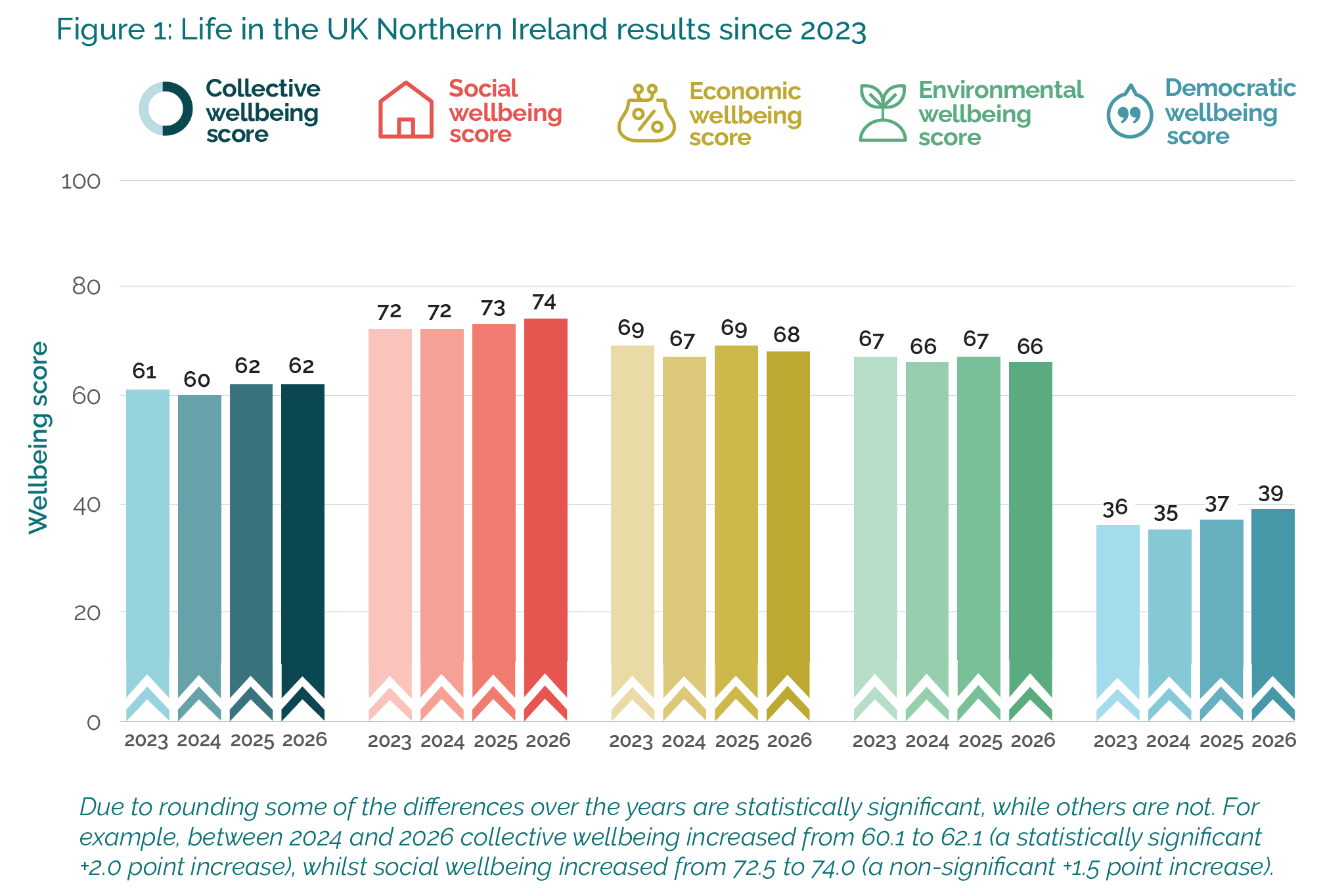
The overall score for collective wellbeing in Northern Ireland in 2026 is 62 out of a possible 100. This marks an improvement since 2024.
While there have been no statistically significant changes to social, economic, or environmental wellbeing since 2023, democratic wellbeing has seen a statistically significant increase, rising to 39 from 36. This has been shaped by a rise in trust in the UK Government and in other institutions such as banks.
Understanding what influences collective wellbeing
The findings of the 2026 Life in the UK index for Northern Ireland indicate a positive change to collective wellbeing, largely driven by the improvements we have seen in democratic wellbeing.
The effect that improved democratic wellbeing has had on overall collective wellbeing in Northern Ireland demonstrates the central importance of strengthening trust in and influence over the institutions that shape our lives. Furthermore, while at the overall UK level several domain scores were lower than in one or more previous years, in Northern Ireland these decreases have not occurred. At the same time, the index tells us that people’s experience of life in Northern Ireland is still shaped by a wide range of demographic factors, and that inequalities persist.
In 2026 the following factor stands out as particularly important in predicting a higher collective wellbeing score in Northern Ireland:
- Having a higher household income. People with annual household incomes of £100,000 and above have a collective wellbeing score of 72. People with an annual household income of between £52,000 and £99,999 have some of the highest collective wellbeing scores (66), and those with an annual household income of between £26,000 and £51,999 have a collective wellbeing score of 62. Meanwhile, those with an annual household income of below £26,000 have a collective wellbeing score of 56, 16 points lower than for those in the highest income bracket.1
The following factors are also notable influences on collective wellbeing in Northern Ireland:
- Being disabled. Disabled people have a collective wellbeing score of 56, eight points lower than for those who are not disabled (64).
- Living in social housing. People who live in social housing have a collective wellbeing score of 50, 14 points lower than for homeowners (64). 2
- Being from a Catholic community background. People from a Catholic community background have a collective wellbeing score of 59, six points lower than for those from a Protestant community background (65).
- Not being a graduate. Non-graduates have an average collective wellbeing score of 61, four points lower than for those who are graduates (65).
Collective wellbeing map
Social wellbeing is about everyone being able to achieve their potential and contribute to society because they have their basic needs met. Our basic needs include feeling healthy, having access to services, feeling safe in and connected with our communities, and being free from discrimination.
To determine trends in social wellbeing across Northern Ireland, we asked questions about access to services, community relationships, safety and community cohesion, and self-reported health and mental health.
The groups most likely to experience high levels of social wellbeing in Northern Ireland in 2026 are:
- Those with annual household incomes of £100,000 and above, who have a social wellbeing score of 84, 18 points higher than for those with annual household incomes of below £26,000 (66). People whose annual household income is between £52,000 and £99,999 also have a higher social wellbeing score of 79.
- Men, who have a social wellbeing score of 77, six points higher than for women (71).
The groups most likely to experience low levels of social wellbeing in Northern Ireland in 2026 are:
- Disabled people, who have a social wellbeing score of 64, 13 points lower than for people who are not disabled (77).
- People from a Catholic community background, who have a social wellbeing score of 72, four points lower than for those from a Protestant community background (76).
Social wellbeing: breakdown of results
There have been few changes to the factors that make up social wellbeing, but more people feel able to rely on others in their neighbourhood than in previous years.
The figures below show the trends since 2023 in the questions we ask around social wellbeing.
Perceptions of general and mental health
- Around two-thirds (67%) of people say that they are in good general health, while just under two-thirds (63%) say they are in good mental health.
Community cohesion
- A quarter (25%) of people feel unsafe walking alone in their neighbourhood after dark, similar to previous years and the UK average.
- Four in five (78%) people feel that they could rely on someone in their neighbourhood to help them if they were alone and needed help, eight percentage points higher than in 2024 and 12 percentage points higher than the UK average.
- Two in five (40%) people have experienced discrimination in the last 12 months, similar to previous years and the UK average.
Access to services
- Almost three in ten (28%) people find it difficult to access public transport that gets them where they want to go, ten percentage points higher than the UK average.
- 86% of people find it easy to access a grocery shop or supermarket in person, similar to previous years and the UK average.
- Three in ten (29%) people find it easy to get a GP appointment at a time they need one, seven percentage points higher than last year. However, this is still 10 percentage points lower than the UK average.
Social wellbeing summary
Northern Ireland’s social wellbeing score of 74 out of a possible 100 remains higher than the UK average of 72.
Within Northern Ireland there has been a positive improvement since 2024 in relation to whether people feel they can rely on others in their neighbourhood. Indeed, people in Northern Ireland are more likely than those in any other part of the UK to feel that they could rely on someone in their neighbourhood to help them if they were alone and needed help.
Northern Ireland has also seen an improvement in how easy people find it to access a GP appointment when they need one compared to 2024 and 2025, however, this remains lower than the UK average.
Additionally, while other parts of the UK have seen losses in relation to some aspects of social wellbeing like general health and access to a grocery shop or supermarket, these negative changes have not been reflected in Northern Ireland.
This overall picture of stability and slight improvement on some measures masks variations according to demographic aspects such as income level, whether someone is disabled, gender, and community background.
Economic wellbeing in Northern Ireland 2026
Northern Ireland scores 68 out of a possible 100 for economic wellbeing.
Economic wellbeing means that everyone has a decent minimum living standard and can absorb financial shocks. This includes access to a decent income, affordability, financial resilience, job opportunities and skills.
To determine trends in economic wellbeing across Northern Ireland, we asked questions about skills and job availability, and the affordability of essential items like food and fuel.
The people most likely to experience high levels of economic wellbeing in Northern Ireland in 2026 are:
- Those with annual household incomes of £100,000 and above, who have an economic wellbeing score of 86. People whose annual household income is between £52,000 and £99,999 have an economic wellbeing score of 77, and those whose annual household income is between £26,000 and £51,999 have an economic wellbeing score of 67. Meanwhile, those with annual household incomes of below £26,000 have an economic wellbeing score of 55, 31 points lower than for those in the highest income bracket.
- Graduates, who have an economic wellbeing score of 75, nine points higher than for non-graduates (66).
- People from a Protestant community background, who have an economic wellbeing score of 72, six points higher than for those from a Catholic community background (66).
The groups most likely to experience low levels of economic wellbeing in Northern Ireland in 2026 are:
- People who live in social housing, who have an economic wellbeing score of 46, 26 points lower than for homeowners (72).
- People in households with one or more children under the age of 16, who have an economic wellbeing score of 63. This is eight points lower than for those in households with no children (71).
- Disabled people, who have an economic wellbeing score of 60, 12 points lower than for people who are not disabled (72).
- People in the most deprived areas (IMD1), who have an economic wellbeing score of 58, 19 points lower than for those in the least deprived areas (77).3
Economic wellbeing: breakdown of results
People feel less able to afford to heat their homes adequately in 2026 than in 2025, falling back to the levels seen in 2023 and 2024. They are also less likely to be able to afford necessities than in other parts of the UK, but are more satisfied with their skills than in 2023 and more satisfied with local job opportunities than the rest of the UK.
The figures below show the trends since 2023 in the questions we ask around economic wellbeing.
Perceptions of education, skills and local job opportunities
- More than four in five (83%) people are satisfied with their education and skills, seven percentage points higher than in 2023.
- A third (32%) of people are satisfied with the availability of job opportunities in their local area, ten percentage points higher than the UK average.
Affordability of essential items
- Just under nine in ten (87%) people can afford to buy enough food for everyone in the household, similar to previous years and the UK average.
- Just under three-quarters (73%) of people can afford to keep their home adequately warm, lower than the UK average of 79%.
- Just over half (55%) of people can afford to pay an unexpected but necessary expense of £850, six percentage points lower than the UK average.
Affordability of leisure activities
- One in six (16%) people cannot afford to socialise outside of their home once a month, four percentage points higher than the UK average.
- A quarter (26%) of people cannot afford to pay for a week’s annual holiday away from home, similar to previous years and the UK average.
Economic wellbeing summary
With a score of 68, people in Northern Ireland no longer face lower economic wellbeing than the UK average. People in Northern Ireland are more satisfied with job opportunities in their local area than people in other parts of the UK, and are more likely to be satisfied with their education and skills than they were in 2023.
However, they are less likely to be able to afford to heat their homes compared to other parts of the UK. While 2025 saw a welcome improvement on this measure in Northern Ireland, in 2026 it has fallen back to the levels seen in 2024.
It is unsurprising that those with the highest incomes have higher economic wellbeing, and the gap between the highest and lowest earners remains vast at 31 points. There are also wide inequalities between homeowners and people who live in social housing, and between graduates and non-graduates.
Other factors such as having children in the household, being disabled, living in an area of high deprivation, or being from a Catholic community background also contribute to lower economic wellbeing scores. Many of these factors are systemic, and individuals cannot address them alone.
Environmental wellbeing in Northern Ireland 2026
Northern Ireland scores 66 out of a possible 100 for environmental wellbeing.
Environmental wellbeing means that everyone has access to green and blue spaces and collectively we live within the planet’s natural resources, protecting the environment for future generations.
To determine trends in environmental wellbeing across Northern Ireland, we asked questions about access to and the quality of local parks, rivers and other green and blue spaces, and about noise pollution, air pollution, and litter in local areas. We also askedabout levels of satisfaction with efforts to preserve the environment.
The people most likely to experience high levels of environmental wellbeing in Northern Ireland in 2026 are:
- Those with annual household incomes of £100,000 and above, who have an environmental wellbeing score of 73, nine points higher than for those with annual household incomes of below £26,000 (64).
- People aged 55 and over, who have an environmental wellbeing score of 71, six points higher than for people aged 35 to 54 (65) and nine points higher than for those aged 16 to 34 (62).4
The groups most likely to experience low levels of environmental wellbeing in Northern Ireland in 2026 are:
- People who live in Belfast, who have an environmental wellbeing score of 61, 10 points lower than for those in the North of Northern Ireland (71).5
Environmental wellbeing: breakdown of results
Satisfaction with the local area has not improved, while satisfaction with efforts to preserve the environment in the UK is improving.
The figures below show the trends since 2023 in the questions we ask around environmental wellbeing.
Issues with quality of local environment
- Just over half (52%) of people experience problems with noise pollution, 12 percentage points lower than the UK average.
- Two in five (41%) people experience problems with air quality in their local area, 12 percentage points lower than the UK average.
- Four in five (80%) people experience problems with litter in their local area, six percentage points higher than in 2023.
Perception of local public, green or open space and efforts to preserve the environment in the UK
- Two-thirds (65%) of people are satisfied with the quality of local public, green or open space, but this has seen no improvement since 2023.
- Three in ten (30%) people are satisfied with efforts to preserve the environment in the UK, eight percentage points higher than in 2023.
Environmental wellbeing summary
At 66, environmental wellbeing in Northern Ireland is three points higher than the UK average.
In particular, people in Northern Ireland experience fewer problems with noise pollution and air quality in their local neighbourhood than the UK average. People in Northern Ireland are now more likely to be satisfied with efforts to preserve the environment in the UK than they were in previous years.
However, other areas of environmental wellbeing have declined since 2023, with people more likely to experience problems with litter on the street in their local area, and no real movement in how satisfied people are with public, green, or open spaces near them.
Environmental wellbeing also continues to vary considerably depending on factors suchas income, age, and region.
Democratic wellbeing in Northern Ireland 2026
Northern Ireland scores 39 out of a possible 100 for democratic wellbeing.
Democratic wellbeing is about everyone having a voice in decisions that affect them. This means having local and national leaders who support participation, foster trust, and encourage diversity.
To understand democratic wellbeing in Northern Ireland in 2026, we asked questions about levels of trust in local, regional and national government(s) as well as other national institutions, and perceptions of personal ability to influence decisions.
While markedly low across the board, and the lowest of any of our four wellbeing domains, the people with the highest levels of democratic wellbeing in Northern Ireland in 2026 are:
- Graduates, who have a democratic wellbeing score of 43, five points higher than for non-graduates (38).
- Those with annual household incomes of £100,000 and above, who have a democratic wellbeing score of 45, seven points higher than for those with annual household incomes of below £26,000 (38).
The groups most likely to experience low levels of democratic wellbeing in Northern Ireland in 2026 are:
- People aged 35 to 54, who have a democratic wellbeing score of 35, seven points lower than for people aged 16 to 34 (42).
- People from a Catholic community background, who have a democratic wellbeing score of 36, six points lower than for those from a Protestant community background (42).
- Disabled people, who have a democratic wellbeing score of 36, five points lower than for people who are not disabled (41).
Democratic wellbeing: breakdown of results
Trust in the UK Government and the Northern Ireland Executive have improved since 2023, and trust in institutions like banks is also improving.
The figures below show the trends since 2023 in the questions we ask around democratic wellbeing.
Perceptions of ability to influence decisions
- Just 5% of people feel that they can influence decisions affecting the UK as a whole, lower than the UK average. However, the proportion of people who disagree that they can influence decisions affecting the UK has fallen by six percentage points since 2023.
- Seven in ten (69%) people do not feel that they can influence decisions affecting Northern Ireland, similar to previous years.
- 56% of people disagree that they can influence decisions affecting their local area, similar to the UK average.
Trust in government and politicians
- Half (49%) of people have low trust in the UK Government, a twelve percentage-point improvement since 2023.
- Over half (53%) of people have low trust in MPs, similar to last year but an improvement compared to 2023 and 2024.
- Three in ten (30%) people have low trust in the local council for their area, similar to the UK average.
Trust in Northern Ireland Executive and politicians
- Just under half (48%) of people have low trust in the Northern Ireland Executive, an eighteen percentage-point improvement since 2023.
- A similar percentage (46%) have low trust in MLAs, a seventeen percentage-point improvement since 2023.
Trust in institutions
- Three in ten (29%) people have high trust in the police, 10 percentage points higher than in 2024.
- A quarter (25%) of people have low trust in the legal system and courts, similar to previous years and the UK average.
- Three in ten (29%) people have high trust in banks, six percentage points higher than in 2025 and the highest rate in Northern Ireland since the Life in the UK index began in 2023.
Trust in media and tech
- More than a third (36%) of people have low trust in the news media, similar to previous years and the UK average.
- Nearly two-thirds (64%) of people have low trust in social media (e.g. Facebook, X, Instagram, YouTube, TikTok), similar to previous years and the UK average.
- Half (49%) of people have low trust in big tech companies, similar to previous years and the UK average.
Democratic wellbeing summary
Democratic wellbeing in Northern Ireland has seen a modest but sustained improvement, and at 39 is now four points higher than it was in 2024. This is the largest change seen in any score across all four jurisdictions of the UK.
The improvements we saw last year to trust in the UK Government and the Executive have largely been retained, and in 2026 more people have high trust in MLAs than they did in 2023. While these improvements should not be underestimated, trust remains fragile. Around half of people still say they have low trust in the UK Government and the Executive, and three in ten have low trust in the local council for their area.
This year has seen an increase in trust in other institutions like banks, which also play a part in our democratic wellbeing, and people are less likely to actively disagree that they can influence the decisions that affect the UK than they were in 2023. However, only five percent feel that they can influence decisions affecting the UK, and 11% that they can influence decisions affecting Northern Ireland. This tells us that people often remain shut out from the decisions impacting their lives.
Low trust in other institutions like social media and big tech point to a society in which people often find it hard to trust the systems they encounter every day and that provide wider context for democratic wellbeing.
Get in touch
Want to chat about Life in the UK 2026 Northern Ireland? Get in touch with Susan.

- The base size for people with an annual household income of £100,000 and above was smaller than for other groups at 62 people, so findings should be treated with caution. ↩︎
- The base size for social housing tenants was smaller than for other groups at 55 people, so findings should be treated with caution. ↩︎
- Indices of multiple deprivation (IMD) is a measure of relative deprivation for small, fixed geographic areas of the UK. IMD classifies these areas into five quintiles based on relative disadvantage, with quintile 1 (‘IMD1’) being the most deprived and quintile 5 (‘IMD5’) being the least deprived. ↩︎
- The base size for 16- to 34-year-olds was smaller than for other groups at 65 people, so findings should be treated with caution. ↩︎
- The base sizes for people in the North of Northern Ireland (93) and Belfast (99) were smaller than for other groups, so findings should be treated with caution. ↩︎
Help us make the case for wellbeing policy
Keep in touch with Carnegie UK’s research and activities. Learn more about ways to get involved with our work.
"*" indicates required fields
Social wellbeing in Northern Ireland 2026
Northern Ireland scores 74 out of a possible 100 for social wellbeing.