Listening, learning and building change together: Carnegie UK’s partnership with the Poverty Truth Network
-

- Hannah Paylor, Carnegie UK
- 25 May 2026
- 5 minute read
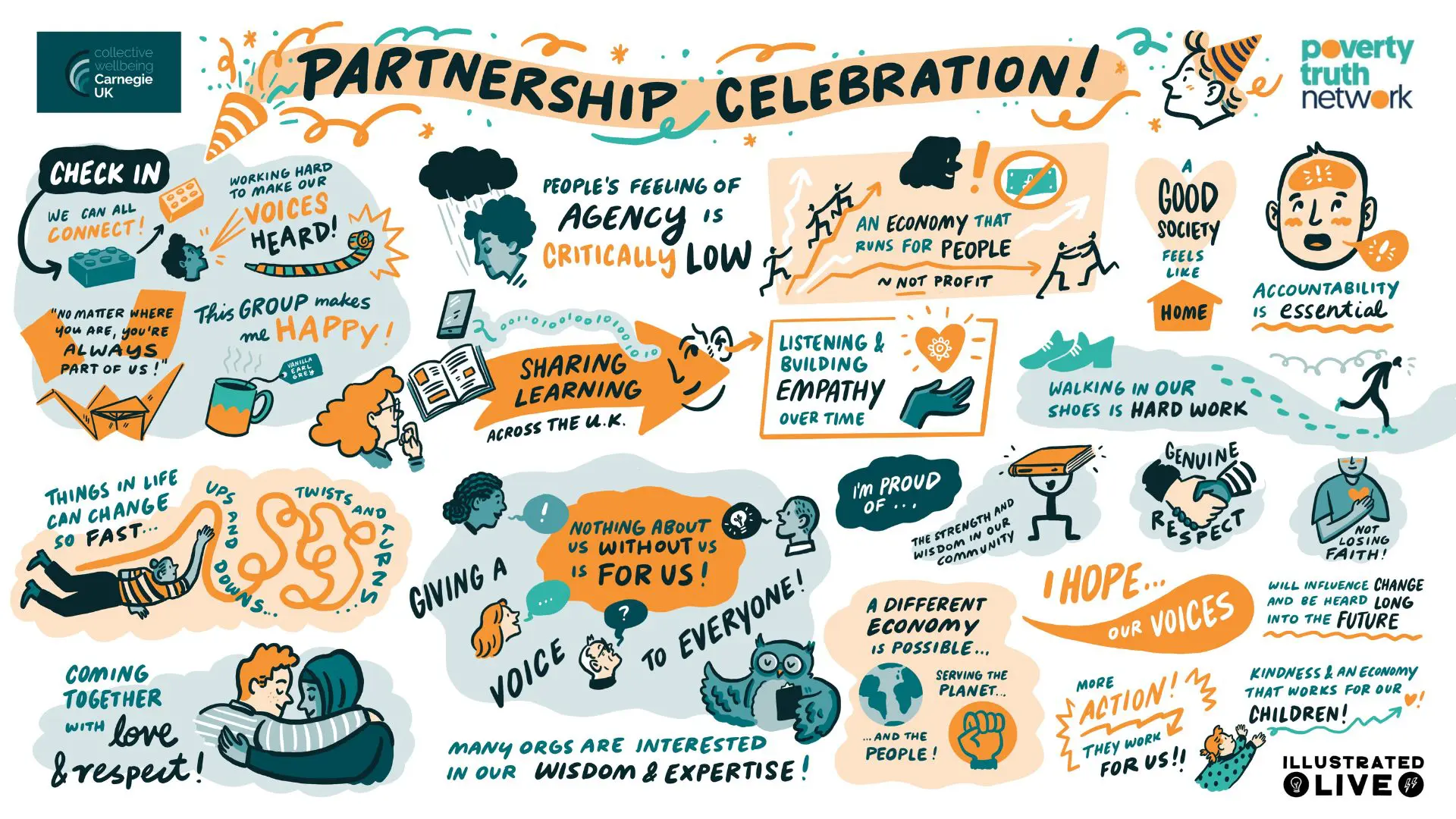
Between April 2023 and March 2026, Carnegie UK and the Poverty Truth Network came together to learn about wellbeing and how change happens through deep listening and discussing solutions together. Rooted in the Poverty Truth’s motto that “nothing about us, without us, is for us”, the partnership grew from a recognition that research and policy conversations can often miss important voices, and from a commitment to ensure that the wisdom of people struggling against poverty – and with low wellbeing – is integral to the story told about what life is like for people living in the UK today.
At its centre, the partnership reflected a shared belief that lasting social change happens through building relationships. The goal was to better understand the realities and consequences of inequality, to imagine a society where collective wellbeing sits at the heart of decision-making, and to explore together how that vision could become a reality.
Like any deeply relational work, that is centred on trust and human connection, the partnership achieved more than its initial aims: it created fresh insight, built lasting friendships, and showed that trust and honest exchange are not an optional extra to policymaking, but should be inherent in the process of gathering evidence itself.
Over three years, people convened in Manchester, Coatbridge and Swansea and met regularly online to stay connected over time. During these sessions, people shared meals, stories, hopes and frustrations; they reflected together on what collective wellbeing would look, sound, taste and feel like; and they made space for vulnerability, humour and mutual care.
Repeatedly, the work showed that some of the most important learning happens not only in formal discussion, but in the spaces between sessions, when trust deepens and people begin to know each other as equals.
Each year of the project brought a different focus:
In 2023, participants reflected on Carnegie UK’s Life in the UK research and explored what collective wellbeing looked, sounded, tasted and felt like in everyday life.
In 2024, attention turned to democratic wellbeing and the democratic deficit experienced by many people, but particularly people living in poverty. We imagined a democracy where decision-makers walked in the shoes of their constituents for a day, created campaign placards, developed the idea of a Poverty Truth Parliament, and collectively wrote a Poverty Truth Maiden Speech. As many new MPs took their seats in Parliament for the first time following the 2024 election, the speech included the things members of the Poverty Truth Network would say to decision-makers if they knew they were going to be heard.
The themes that emerged were powerful: a call to challenge the stigma and misrepresentation attached to poverty, a demand for leaders to listen with seriousness and empathy, and a reminder that people living in poverty are too often treated as a problem rather than recognised as experts in their own lives.
In 2025, the conversation shifted to the idea of a new social contract, using the image of a three-legged stool to explore the roles of individuals, communities and the state in how we live well together. We discussed the political and social stories that divide us and concluded that collective wellbeing is being significantly impacted by narratives of division.
The partnership demonstrated that listening over time produces a richer and more human understanding of poverty than short-term consultation ever could, precisely because it is grounded in trust.
It showed that people with experience of poverty bring insight, challenge and imagination that can strengthen policy thinking and public leadership when they are engaged as partners rather than subjects.
As the formal partnership ended in 2026, its legacy was not a neat set of conclusions, but something more valuable: stronger relationships, deeper understanding and greater confidence about what is possible when people build change together. For Carnegie UK, the partnership with the Poverty Truth Network has been a powerful example of how collective wellbeing can move from principle to practice through sustained connection, deep listening and mutual respect. Together, we learned that meaningful change starts not only by hearing voices too often left out of the room, but by building the relationships that allow those voices to shape what happens next.
Illustrations by Jules for Illustrated Live. Image credit: katiechappell.com
Help us make the case for wellbeing policy
Keep in touch with Carnegie UK’s research and activities. Learn more about ways to get involved with our work.
"*" indicates required fields