Learning for impact

-

- Adam Lang, Carnegie UK
- 7 October 2026
- 5 minute read

In recent months, the Carnegie UK team and our Board of Trustees have worked closely with Lucent consultancy to develop our approach to learning and impact. As this work nears its conclusion, I want to reflect on why “second-loop learning” matters for an independent policy foundation and what it takes to really embed it in our work.
Advance warning: strategy development and theories of change are the kinds of things that get me out of bed in the morning – odd, I know – so this may get a bit geeky.
What is the “second loop” of learning governance?
Traditional governance in policy organisations and grant-making trusts is often anchored in the familiar machinery of performance management: KPIs, milestone tracking and short-term output measures. These provide management and boards with assurance and oversight. Yet, as our Chair, David Emerson, recently argued in his reflections on the future of good governance, an emphasis on “proving” often obscures the messy reality of how systemic social change actually happens.
For independent policy foundations such as Carnegie UK that work to improve policymaking across multiple complex political landscapes, linear metrics are rarely fit for purpose. Policy change and system innovation are iterative, uncertain and unlikely to fit neatly into annual reporting cycles. Recognising this has prompted a comprehensive review of our theory of change and a shift from governing through traditional performance measures to governing through learning.
Our work with Lucent draws on the double-loop learning model developed by Harvard professor Chris Argyris in the 1970s. It encourages organisations not only to adjust their actions when problems arise, but also to question the assumptions, values and goals shaping those actions. The model distinguishes between two loops of reflection:
- First-loop learning asks whether we are delivering a project efficiently.
- Second-loop learning goes further by interrogating the fundamental assumptions and strategies that shape what we do.
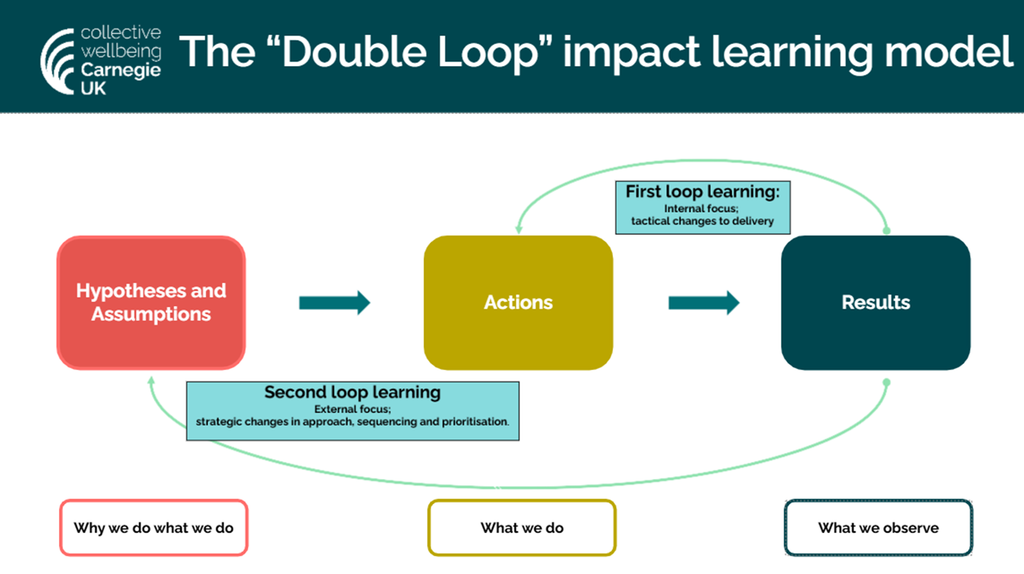
While this model definitely makes for a nice visual, actively putting it into our governance practice and day to day work is harder. Three challenges in particular stand out in relation to this: reconciling accountability with uncertainty, resisting short-term pressures, and creating the conditions for sustained self-challenge.
1. Reconciling accountability with uncertainty
Moving to double-loop learning creates a practical tension. Charity trustees have fiduciary and regulatory duties to ensure accountability, stewardship and effective resource allocation. These duties are often met through evidence of attribution: showing how a particular input contributed to an output or outcome.
Second-loop learning, by contrast, prioritises contribution over attribution. It recognises that an independent foundation is usually one of many actors seeking to influence a complex system. This is especially true for Carnegie UK: we do not provide services, award grants or represent a membership, and we receive no third-party funding. Governing our work effectively therefore requires trustees to become comfortable with ambiguity and to value negative findings, strategic pivots and unexpected insights alongside successful delivery.
This demands a significant cultural shift away from management and governance practices familiar to most staff and trustees. Board meetings, papers and oversight processes must reward genuine enquiry and the testing of core assumptions, rather than defensive — and often performative — accounts of success.
2. Resisting short-term optics
Political cycles and funding pressures often steer traditional governance and accountability towards immediate, visible impact. Second-loop learning instead requires long time horizons, patience and permission to fail safely. When a foundation seeks to change a policy system or challenge established ways of working, feedback loops that clearly demonstrate impact may take years or even decades to mature. As such, the governance challenge is to protect space for deep reflection while giving boards and external stakeholders credible evidence that the work is purposeful, effective, adaptive and responsible.
3. Institutionalising self-challenge
It is relatively easy for a policy organisation to study external systems, but much harder to turn that analytical lens inward. Second-loop learning requires us as a policy team to challenge our own orthodoxies, blind spots and established ways of working – regularly and methodically.
For a board, this means cultivating a culture in which scrutinising our core assumptions signals intellectual rigour rather than institutional weakness. Sustaining this kind of reflection and self-challenge is difficult. It requires the organisation to keep reassessing the processes that support it, with buy-in for this kind of reflective work at every level.
Embracing the “So what?”
Ultimately, learning-led governance is not about abandoning rigour but redefining what it requires. Shifting our focus from the “What?” of delivery to the “So what?” and “Now what?” of systemic understanding means testing our assumptions, being honest about what is not working and using that insight to adapt.
This is much harder in practice than on paper because it requires us to set aside a lot of learned professional behaviours. When time and intellectual bandwidth are stretched, it is easy to default to what feels familiar and comfortable. Doing so, however, would mean retreating from the deeper enquiry that learning-led governance demands.
If independent foundations are to retain their distinctive capacity to create space for bold, long-term change, we must govern learning as deliberately as most organisations govern resources, even when it is difficult. This is because it is only by having a sustained focus on the “So what?” of our work that we can hope to improve our impact over time and make a meaningful difference to people’s lives at scale.
Help us make the case for wellbeing policy
Keep in touch with Carnegie UK’s research and activities. Learn more about ways to get involved with our work.
"*" indicates required fields