
This is the latest edition of our Life in the UK – Wales index, and with four years’ worth of data trends from our index we are able to take a slightly longer-term view of how people across Wales are living.
- Democracy
- Economy
- Environment
- Evidence and reports
- Inequality
- Measuring wellbeing
- Society
- Carnegie UK
- 2 November 2026
- ISBN: 978-1-917536-19-6
- 25 minute read
Our collective wellbeing in Wales 2026
Collective wellbeing is about everyone having what they need to live well now and into the future. It goes beyond individual happiness or health. Instead, it looks at the holistic, bigger picture: how our society, economy, environment and democracy work together to support people and communities.
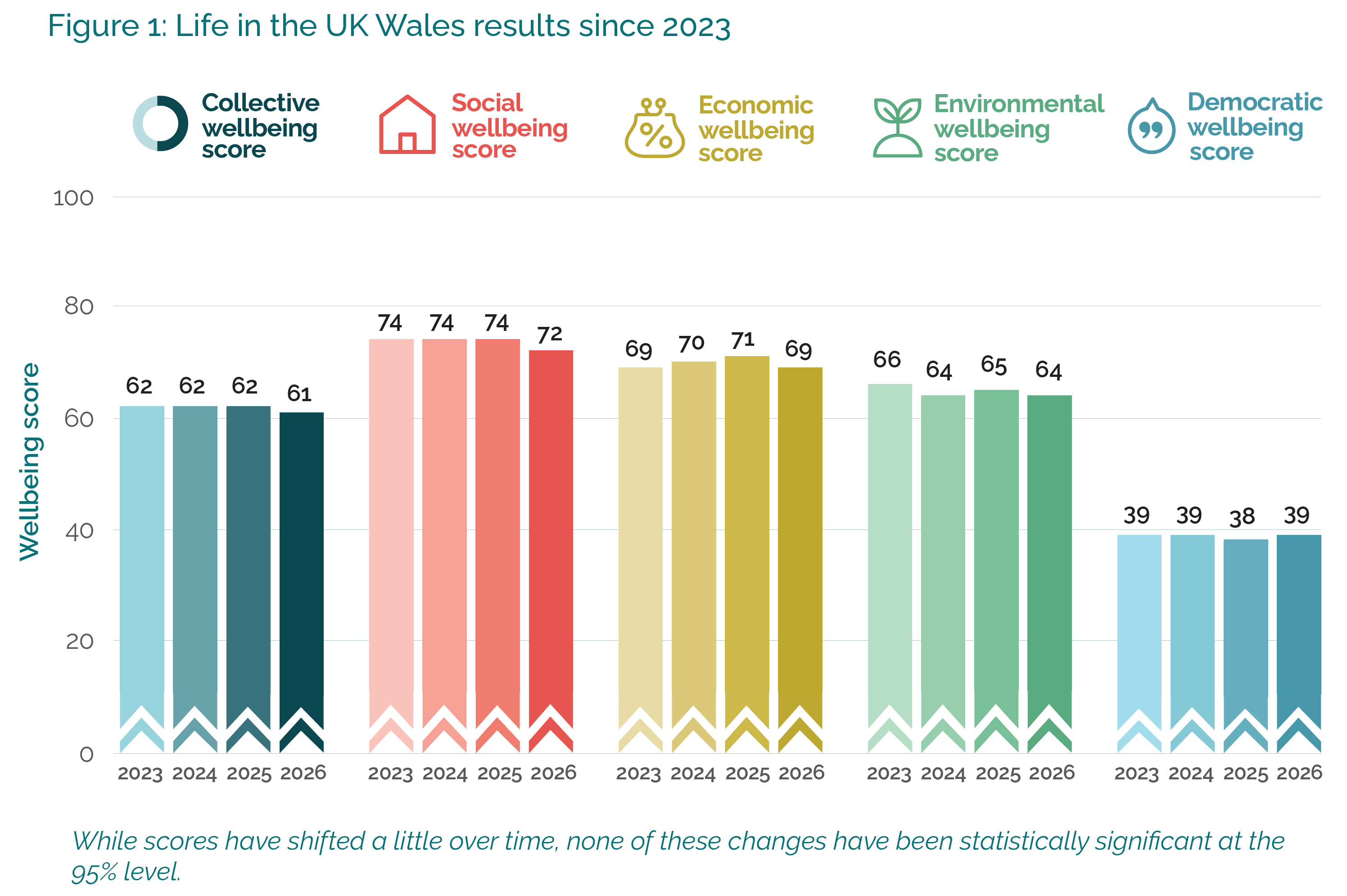
The overall score for collective wellbeing in Wales in 2026 is 61 out of a possible 100.
While each score has fluctuated over time, none of these changes have been statistically significant in Wales.
Collective wellbeing and each domain are shaped by a wide range of factors, many of which take time to influence outcomes. Our findings show that meaningful positive progress across domains is yet to be made in Wales.
Understanding what influences collective wellbeing
The lack of statistically significant change in scores this year points to a picture ofstagnation for collective wellbeing in Wales.
The index tells us that people experience very different levels of wellbeing depending on their circumstances, and that life in Wales is still shaped by inequalities between and within communities.
In 2026 the following factors stand out as particularly significant in predicting a lower or higher collective wellbeing score in Wales:
- Being disabled. Disabled people have a collective wellbeing score of 52, 12 points lower than for people who are not disabled (64).
- Having a lower household income. People with annual household incomes of under £26,000 a year have a collective wellbeing score of 54, 12 points lower than for those whose annual household income is between £52,000 and £99,999 (66).
- Being 55 or over. People aged 55 and over have a collective wellbeing score of 65, seven points higher than for those aged 16 to 34 (58).1
- Being a graduate. Graduates have a collective wellbeing score of 65, six points higher than for non-graduates (59).
The following factors are also notable influences on collective wellbeing:
Living in the most deprived areas. People who live in the most deprived areas (IMD1) have a collective wellbeing score of 53, 15 points lower than for those who live in the least deprived areas (68).2
Having children in the household. People who have one or more children under the age of 16 in their household have a collective wellbeing score of 56, seven points lower than for those with no children in the household (63).3
Collective wellbeing map
Social wellbeing is about everyone being able to achieve their potential and contribute to society because they have their basic needs met. Our basic needs include feeling healthy, having access to services, feeling safe in and connected with our communities, and being free from discrimination.
To determine trends in social wellbeing across Wales, we asked questions about access to services, community relationships, safety and community cohesion, and self-reported health and mental health.
The groups most likely to experience high levels of social wellbeing in Wales in 2026 are:
- People aged 55 and over, who have a social wellbeing score of 77, 10 points higher than for those aged 16 to 34 (67).
The groups most likely to experience low levels of social wellbeing in Wales in 2026 are:
- People who are disabled, who have a social wellbeing score of 60, 17 points lower than for those who are not disabled (77).
Social wellbeing: breakdown of results
Experiences of discrimination have risen over the last three years, and perceptions of community safety remain higher than the UK average.
The figures below show the trends since 2023 in the questions we ask around social wellbeing.
Perceptions of general and mental health
- Six in ten (61%) people say that their general health is good, six percentage points lower than the UK average.
- One in ten (11%) people say that their mental health is bad, similar to 2025 but four percentage points higher than in 2024.
Community cohesion
- Three-quarters (76%) of people feel safe walking alone in their neighbourhood after dark, five percentage points higher than the UK average.
- One in seven (15%) people do not feel that they could rely on someone in their neighbourhood to help them, similar to last year but higher than in 2024.
- 44% of people reported experiencing discrimination in the 12 months before the survey, 11 percentage points higher than in 2023.
Access to services
- 28% of people find it difficult to access public transport that gets them where they need to go, 10 percentage points higher than the UK average.
- Nearly one in ten people (9%) find it difficult to access a grocery shop or supermarket in person, four percentage points higher than last year.
- Just under half (46%) of people find it difficult to get a GP appointment at a time when they need one, an eleven percentage-point improvement since 2023.
Social wellbeing summary
Wales’ social wellbeing score of 72 out of 100 in 2026 is similar to that seen in previous years. Although it is two points lower than we saw in 2023, 2024, and 2025, this is not a statistically significant drop and is one we will continue to monitor. Wales’ social wellbeing score is also no longer higher than the UK average, which has been the case in previous years.
There have been few changes to many of the underlying factors behind social wellbeing. General health remains lower than the UK average, but has not seen any sustained improvements or declines, and mental health too is largely reflective of previous years’ scores. On a positive note, fewer people find it difficult to access a GP appointment at a time when they need one compared to 2023.
However, there has been an increase in the proportion of people who experience discrimination since Life in the UK first reported in 2023. Similarly, there has been a decline in how easy people find it to access a grocery shop or supermarket in person.
Economic wellbeing in Wales 2026
Wales scores 69 out of a possible 100 for economic wellbeing.
Economic wellbeing means that everyone has a decent minimum living standard and can absorb financial shocks. This includes access to a decent income, affordability, financial resilience, job opportunities and skills.
To determine trends in economic wellbeing across Wales, we asked questions about skills and job availability, and the affordability of essential items like food and fuel.
The people most likely to experience high levels of economic wellbeing in Wales in 2026 are:
- People aged 55 and over, who have an economic wellbeing score of 75, 11 points higher than for those aged 16 to 34 (64).
- Graduates, who have an economic wellbeing score of 75, nine points higher than for non-graduates (66).
- Men, who have an economic wellbeing score of 70, two points higher than for women (68).
The groups most likely to experience low levels of economic wellbeing in Wales in 2026 are:
- People with an annual household income of below £26,000, who have an economic wellbeing score of 55, 23 points lower than for those with an annual income of £52,000 and over (78).
- Disabled people, who have an economic wellbeing score of 59, 13 points lower than for those who are not disabled (72).
- People with one or more children under the age of 16 in their household, who have an economic wellbeing score of 62, nine points lower than for those with no children in their household (71).
- People who live in the most deprived areas (IMD1), who have an economic wellbeing score of 58, 19 points lower than for those in the least deprived areas (77).
Economic wellbeing: breakdown of results
The questions which underpin economic wellbeing are largely unchanged. However, satisfaction with local job opportunities has reached the lowest level yet recorded by Life in the UK in Wales.
The figures below show the trends since 2023 in the questions we ask around economic wellbeing.
Perceptions of education, skills and local job opportunities
- Four in five (79%) people in Wales are satisfied with their education and skills, similar to previous years.
- Fewer than one in five (17%) people in Wales are satisfied with the availability of jobs in their local area. This is eight percentage points lower than last year, thirteen percentage points lower than 2023 and five percentage points lower than the UK average.
Affordability of essential items
- 7% of people in Wales cannot afford to buy enough food for everyone in the household, similar to previous years and the UK average.
- One in seven (14%) people in Wales cannot afford to keep their home adequately warm, similar to previous years and the UK average.
- Almost a third of people in Wales (32%) say that they cannot afford to pay an unexpected but necessary expense of £850, similar to previous years.
Affordability of leisure activities
- Four in five (80%) people in Wales agree that they can afford to socialise outside their home once a month if they want to, similar to previous years.
- A quarter (24%) of people cannot afford to pay for a week’s annual holiday away from home, similar to previous years.
Economic wellbeing summary
Economic wellbeing in Wales remains similar to previous years. As with social wellbeing, the large majority of the factors behind economic wellbeing remain stable or saw only minor fluctuations this year.
In general, economic wellbeing in Wales also largely aligns with that of the UK overall, with few differences across areas like people’s ability to afford life’s basics, and satisfaction with education and skills.
The exception relates to satisfaction with job opportunities, which has followed a downward trend since Life in the UK began reporting in 2023 and has fallen more sharply since 2025. Now, just 17% of people in Wales are satisfied with the availability of job opportunities for people in their local area, compared to 30% three years ago. This is a pattern mirrored across much of the UK, but seen more acutely in Wales.
Environmental wellbeing in Wales 2026
Wales scores 64 out of a possible 100 for environmental wellbeing.
Environmental wellbeing means that everyone has access to green and blue spaces and collectively we live within the planet’s natural resources, protecting the environment for future generations.
To determine trends in environmental wellbeing across Wales, we asked questions about access to and the quality of local parks, rivers and other green and blue spaces, and about noise pollution, air pollution, and litter in local areas. We also asked about levels of satisfaction with efforts to preserve the environment.
The people most likely to experience high levels of environmental wellbeing in Wales in 2026 are:
- People in the least deprived areas (IMD5), who have an environmental wellbeing score of 72, 18 points higher than for those in the most deprived areas (54).
- People aged 55 and above, who have an average environmental wellbeing score of 69, 10 points higher than for people aged 16 to 34 (59). People aged 35 to 54 also have a higher environmental wellbeing score of 61.
- People who live in a rural area, who have an environmental wellbeing score of 71, 11 points higher than for those in urban areas (60).
The groups most likely to experience low levels of environmental wellbeing in Wales in 2026 are:
- Disabled people, who have an environmental wellbeing score of 56, 11 points lower than for people who are not disabled (67).
Environmental wellbeing: breakdown of results
The questions which underpin environmental wellbeing have remained largely unchanged in Wales, though issues remain prevalent and outcomes still differ from other parts of the UK.
The figures below show the trends since 2023 in the questions we ask around environmental wellbeing.
Issues with quality of local environment
- Just over three-fifths (61%) of people say they have experienced issues with noise pollution in their local area. This is 10 percentage points higher than in Scotland, and eight percentage points higher than in Northern Ireland.
- Nearly half (48%) of people experience problems with air quality, 12 percentage points higher than in Scotland but seven percentage points lower than in England. People in Wales are now as likely as not to experience problems with air quality.
- 85% of people in Wales experience problems with litter in their local area, similar to the UK average.
Perception of local public, green or open space and efforts to preserve the environment in the UK
- Seven in ten (70%) people in Wales are satisfied with the quality of the public, green or open space in their local area.
- Three in ten (29%) people in Wales say they are satisfied with efforts to preserve the environment in the UK.
Environmental wellbeing summary
At 64, environmental wellbeing in Wales has stayed relatively stable since Life in the UK began reporting in 2023. However, whereas in previous years Wales showed higher environmental wellbeing than the UK average, small deteriorations mean that this is no longer the case in 2026.
Problems with issues like noise pollution, air quality, and litter or rubbish in people’s local areas remain prevalent, and more people are dissatisfied than satisfied with efforts to preserve the environment in the UK. The majority of people are, however, satisfied with the quality of their local public, green, or open space.
Democratic wellbeing in Wales 2026
Wales scores 39 out of a possible 100 for democratic wellbeing.
Democratic wellbeing is about everyone having a voice in decisions that affect them. This means having local and national leaders who support participation, foster trust, and encourage diversity.
To understand democratic wellbeing in Wales in 2026, we asked questions about levels of trust in local, regional and national government(s) as well as other national institutions, and perceptions of personal ability to influence decisions.
While markedly low across the board, and the lowest of any of our four wellbeing domains, the people with the highest levels of democratic wellbeing in Wales in 2026 are:
- Graduates, who have an average democratic wellbeing score of 44, seven points higher than for non-graduates (37).
The groups most likely to experience low levels of democratic wellbeing in Wales in 2026 are:
- People with an annual household income of below £26,000, who have a democratic wellbeing score of 35, seven points lower than for those with an annual household income of £52,000 and over (42).
Democratic wellbeing: breakdown of results
While low, trust in government and perceptions of people’s ability to influence decisions have improved, but trust in some other institutions is falling.
The figures below show the trends since 2023 in the questions we ask around democratic wellbeing.
Perceptions of ability to influence decisions
- Only 8% of people agree that they can influence decisions affecting the UK, although this is six percentage points higher than in 2023.
- Only 14% of people believe that they can influence decisions affecting Wales, although this is six percentage points higher than last year.
- People are a little more likely to feel that they can influence decisions affecting their local area, although still only just under one in five (18%) agree, similar to previous years.
Trust in government and politicians
- Over half (53%) of people in Wales have low trust in the UK Government, the same as last year, though the proportion with high trust has increased since 2024.
- Although only 5% of people in Wales have high trust in MPs, this has increased since 2023.
- Just under a third (31%) of people in Wales have low trust in their local council.
Trust in Welsh Government and politicians
- Just over a third (36%) of people have low trust in the Welsh Government, a seven percentage-point improvement since last year but the same as in 2023.
- Just under 1 in 10 (8%) people have high trust in Welsh Parliament members (MSs), similar to previous years.
Trust in institutions
- Trust in civil institutions has remained broadly similar since the survey began, with almost one in five (18%) reporting low trust in the police and banks, and one in four (25%) citing low trust in the legal system and courts.
Trust in media and tech
- Just under two in five (38%) people have low trust in the news media, similar to previous years and the UK average.
- Almost two-thirds (64%) of people have low trust in social media, eight percentage points higher than in 2023. Just 1% of people have high trust.
- Half (49%) of people have low trust in big tech companies (e.g. Google or Apple), thirteen percentage points higher than in 2023.
Democratic wellbeing summary
As in previous years and as in other jurisdictions, at 39 democratic wellbeing continues to be far lower than for the other domains we measure. However, despite seeing no overall changes at the domain level, there have been improvements in some areas of democratic wellbeing.
It remains true that few people feel able to influence decisions that affect them, but there have been small improvements both at the Wales and UK-wide levels. Similarly, while high trust in the UK Government and Welsh Government remains uncommon (8% and 14%, respectively), there have been some improvements.
Trust in local councils is unchanged, with around a third of people reporting low trust, and a similar proportion to previous years feeling that they can influence decisions affecting their local area.
There has been an increase in the proportion of people who do not trust big tech companies compared to 2023 and 2024, and trust in social media is even lower. Many people also have low trust in the news media.
Trust in civil institutions like the police and banks is higher than for the other institutions we ask about, with around a quarter of people having high trust in each.
Get in touch
Want to chat about Life in the UK 2026 Wales? Get in touch with Susan.

- The base size for 16- to 34-year-olds was smaller than for other groups at 56 people, so findings should be treated with caution ↩︎
- Indices of multiple deprivation (IMD) is a measure of relative deprivation for small, fixed geographic areas of the UK. IMD classifies these areas into five quintiles based on relative disadvantage, with quintile 1 (‘IMD1’) being the most deprived and quintile 5 (‘IMD5’) being the least deprived. The base sizes for those in IMD1 (98) and IMD5 (97) were smaller than for other groups, so findings should be treated with caution. ↩︎
- The base size for people with children in the household was smaller than for other groups at 78 people, so findings should be treated with caution. ↩︎
Help us make the case for wellbeing policy
Keep in touch with Carnegie UK’s research and activities. Learn more about ways to get involved with our work.
"*" indicates required fields
Social wellbeing in Wales 2026
Wales scores 72 out of a possible 100 for social wellbeing.